
Getting the best mileage from the squeeze-bore guns? (2 Viewers)

Ad: This forum contains affiliate links to products on Amazon and eBay. More information in Terms and rules

tomo pauk

Creator of Interesting Threads
15,384
5,405
Apr 3, 2008
Both from the idea (= other countries and services catching on it), as well as on the best use of the known guns & ammo (mostly what the Germans were making, as well as what was made in the UK with the Littlejohn device). Yes, I know that these squeeze bore was not the best idea, it have had it's specific shortcomings, but this thread is devoted to the guns in question.

To start he ball rolling - leaving the German guns, at least the bigger types like the 75mm, on a towed mount was a mistake IMO. Get them to be self-propelled ASAP. Might've even be a good fit for the Pz-IV turret, unlike the Panther's gun, and use them as anti-tank specialists in the vein of the Sherman Firefly.
 
Both from the idea (= other countries and services catching on it), as well as on the best use of the known guns & ammo (mostly what the Germans were making, as well as what was made in the UK with the Littlejohn device). Yes, I know that these squeeze bore was not the best idea, it have had it's specific shortcomings, but this thread is devoted to the guns in question.

To start he ball rolling - leaving the German guns, at least the bigger types like the 75mm, on a towed mount was a mistake IMO. Get them to be self-propelled ASAP. Might've even be a good fit for the Pz-IV turret, unlike the Panther's gun, and use them as anti-tank specialists in the vein of the Sherman Firefly.
OK, trying to leave the German fascination with gimmicks aside.

The 28/20 guns, just under 2800 built and it was small enough to be useful for troops without motor transport, it was also small enough to be easily mounted in small trucks/heavy cars and in small armored vehicles. The Sd. Kfz 222 armored car being one and the small 1/2 track another. Hard to say if more motor transport would have ben more useful. It gave some needed punch to the parachute and mountain troops.
The 42/28mm guns, about 313 built, mounted on modified 37mm Pak 36 carriages. Some went to the "light" troops. Others were spread around. AP had very good penetration for the size of the gun. Effects on things behind the armor was a little lacking. Ability to fire effective HE is rather lacking, HE projectile weighed 280 grams. A few may have been mounted in 1/2 tracks or on tracked carriers (Bren or French?).
The 75/55mm guns. only around 150 built. Motorizing them may have been more effective. But there are too few to have much effect on the war in general. Might take up more engineering effort to get it into a tank turret than what the would get out of it. Granted that did not stop the Germans from devoting a lot of time and effort into prototypes that went nowhere and could be see to be going nowhere. A taper bore MK IV tank would have been an anti-tank specialist indeed as there may have been no HE round for the gun. While a practice round is listed an HE round is not in common sources (copied from each other?). Gun is a bit longer than the standard 7.5cm/L48 gun and the ammo is bit longer.
With the ban on carbide cores being put into effect in the summer of 1942 and the gun being worthless without the cored ammo things get very iffy. A MK IV with a standard 7.5cm/L43 gun in the Spring-summer-fall of 1942 could fire Pzgr 39, a few left over rounds of Pzgr 40, HE, smoke(?) and perhaps a few shaped charge rounds?
Yes the carbide core ban was not universal and exceptions were made. But the 75/55mm gun had to use tungsten carbide for every service (combat) round fired and each round was going to use up almost double the amount of tungsten as a 50mm round would, let alone the 30mm/37mm rounds used in the aircraft anti-tank rounds. Ground 37mms may have seen issue fade to nothing as a lot of the time the 37mm ground gun could not kill the big Russian tanks even with an AP 40 round.
So a lot depended on what was going on (in some peoples minds) in the winter of 1941 and spring of 1942. Was sticking the big taper bore gun in a tank (MK IV at the time) a good idea or not? It was Nov 1941 when they decided to put the 7.5cm/L43 in the MK IV G and shortly after that decided to put them in the last of the Fs as an emergency. First production MK IVFs with L43 guns left the factory/s in March 1942. The 75/55mm gun was a for sure tank killer, but it could not do anything else. How much time to redo the mounts for tank use? What modifications to the turret?
One source says in the Summer of 1942 (June) the Germans had approximately 170 MK IVs with long guns. How many less if some had been fitted with the 75/55 guns?

A simpler solution may have been to stick them into German MK II, Czech 38 or French Lorraine chassis.
 
The 28/20 guns, just under 2800 built and it was small enough to be useful for troops without motor transport, it was also small enough to be easily mounted in small trucks/heavy cars and in small armored vehicles. The Sd. Kfz 222 armored car being one and the small 1/2 track another. Hard to say if more motor transport would have ben more useful. It gave some needed punch to the parachute and mountain troops.
One wonders how much the 28/20 was actually a good gun to go with anyway? While the set amount of tungsten will last longer here vs. the bigger guns, the actual effect - tank killed - would've probably remained the same if they stuck with the 37mm instead. For the instances where the light weight is a paramount, and as-is the 37 is still too heavy - install the muzzle brakes and perhaps it can fit on the French 25mm carriages, and call it a day?

The 42/28mm guns, about 313 built, mounted on modified 37mm Pak 36 carriages. Some went to the "light" troops. Others were spread around. AP had very good penetration for the size of the gun. Effects on things behind the armor was a little lacking. Ability to fire effective HE is rather lacking, HE projectile weighed 280 grams. A few may have been mounted in 1/2 tracks or on tracked carriers (Bren or French?).
This one would've probably been a good retrofit on the Pz-IIIs that came out from production as armed with the 3.7cm gun? Or even probably for the Pz-38(t). At 500 and 1000m, the penetration is more than double that of the 3.7cm with APCR, or in the ballpark with the short 5cm, that was a gun the turret on the 38(t) will not be accepting happily, if at all.

The 75/55mm guns. only around 150 built. Motorizing them may have been more effective. But there are too few to have much effect on the war in general. Might take up more engineering effort to get it into a tank turret than what the would get out of it. Granted that did not stop the Germans from devoting a lot of time and effort into prototypes that went nowhere and could be see to be going nowhere. A taper bore MK IV tank would have been an anti-tank specialist indeed as there may have been no HE round for the gun. While a practice round is listed an HE round is not in common sources (copied from each other?). Gun is a bit longer than the standard 7.5cm/L48 gun and the ammo is bit longer.
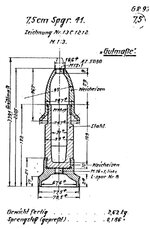
HE round for the 75/55 was supposed to look like this:

55he.jpg

Perhaps the 5cm HE shell might've been adopted as the HE shell here?
The practice round was still good for excellent penetration figures, despite it being made from soft steel; the chance to hit was probably awesome with the speed it had and the small drop.

With the ban on carbide cores being put into effect in the summer of 1942 and the gun being worthless without the cored ammo things get very iffy. A MK IV with a standard 7.5cm/L43 gun in the Spring-summer-fall of 1942 could fire Pzgr 39, a few left over rounds of Pzgr 40, HE, smoke(?) and perhaps a few shaped charge rounds?
Yes the carbide core ban was not universal and exceptions were made. But the 75/55mm gun had to use tungsten carbide for every service (combat) round fired and each round was going to use up almost double the amount of tungsten as a 50mm round would, let alone the 30mm/37mm rounds used in the aircraft anti-tank rounds. Ground 37mms may have seen issue fade to nothing as a lot of the time the 37mm ground gun could not kill the big Russian tanks even with an AP 40 round.

What was not made for the 75/55 was the 'simple' APCBC shot - basically the 57mm zis-2 on steroids. It would've been good for taking on the T-34 beyond 1500m, and against the KV to beyond 1km; even better if the side shot opportunity arises. Not bad for a relatively compact gun that can use no tungsten and has the flat and fast trajectory.
Perhaps make a shot that has just the 1st 1/3rd of the core being from tungsten carbide, the rest from steel?
Also - try and test the APCR shot from the 5cm pak 'wrapped' in the metal container so it fits? Will use less tungsten than the normal pak 41 APCR, and will have the higher MV (that is both good and bad thing here).

WRt, the tungsten use, same thing as with the 28/20mm gun might've been applied to the 37mm getting any APRCs after 1941 - were they actually worth it on the Eastern front? A tungsten-tipped 75/55 will make for an excellent anti-tank system, even the 42mm will be useful, but to me the 37mm APCR, unless it is the biggest AT weapon the platform (basically, an aircraft) can handle, might be an example of trying to gold-plate the wood.

So a lot depended on what was going on (in some peoples minds) in the winter of 1941 and spring of 1942. Was sticking the big taper bore gun in a tank (MK IV at the time) a good idea or not? It was Nov 1941 when they decided to put the 7.5cm/L43 in the MK IV G and shortly after that decided to put them in the last of the Fs as an emergency. First production MK IVFs with L43 guns left the factory/s in March 1942. The 75/55mm gun was a for sure tank killer, but it could not do anything else. How much time to redo the mounts for tank use? What modifications to the turret?
One source says in the Summer of 1942 (June) the Germans had approximately 170 MK IVs with long guns. How many less if some had been fitted with the 75/55 guns?

There was a lot of Pz-IVs with the short gun in 1942. Have the battle-damaged examples being the 1st recipients of the 75/55 gun?
A platform where it should've been perhaps easiest to install this gun in 1942 would've been the Stug-III.
 
For the Americans: Littlejohn adapter for the 37mm M4 gun. It might've made that gun an useful airborne tank-busting piece. One obviously on the P-39, two perhaps under wings of a P-40? Two on the A-20 and the like.
 
What was not made for the 75/55 was the 'simple' APCBC shot - basically the 57mm zis-2 on steroids. It would've been good for taking on the T-34 beyond 1500m, and against the KV to beyond 1km; even better if the side shot opportunity arises. Not bad for a relatively compact gun that can use no tungsten and has the flat and fast trajectory.
Perhaps make a shot that has just the 1st 1/3rd of the core being from tungsten carbide, the rest from steel?
Also - try and test the APCR shot from the 5cm pak 'wrapped' in the metal container so it fits? Will use less tungsten than the normal pak 41 APCR, and will have the higher MV (that is both good and bad thing here).

WRt, the tungsten use, same thing as with the 28/20mm gun might've been applied to the 37mm getting any APRCs after 1941 - were they actually worth it on the Eastern front? A tungsten-tipped 75/55 will make for an excellent anti-tank system, even the 42mm will be useful, but to me the 37mm APCR, unless it is the biggest AT weapon the platform (basically, an aircraft) can handle, might be an example of trying to gold-plate the wood.

There was a lot of Pz-IVs with the short gun in 1942. Have the battle-damaged examples being the 1st recipients of the 75/55 gun?
A platform where it should've been perhaps easiest to install this gun in 1942 would've been the Stug-III.
1764507886723.jpeg

1764507908385.jpeg

Pz IV and III projects with Waffe 0725 (tank version of 75/55) did exist, but didn't go through due to the difficulty of producing the guns and ammo compared to KwK 40.

Steel core 75/55 ammo existed:
1764508130354.jpeg


I'm aware that when Edgar Brandt discussed tungsten carbide cores he left the possibility of using T.C for the tip only and steel for the rest of the core. You lose the increased density but the hard T.C tip still helps a lot as a cap. Otherwise you could use the principle the Soviets used on early APFSDS, tiny T.C core followed by steel (rod in APFSDS) where the steel has a piston effect pushing the core, which can boost penetration.

Best option for Germans would still be to figure out conical muzzle devices (Littlejohn), which would preclude the need for dedicated guns that are difficult to produce. The muzzle device is the main wear part and you can fit it to existing guns (ideally a special device with a muzzle brake for guns that needed one), so even if you run out of APCNR you can still use the gun with normal ammo and the device removed. That's what the French thought about the muzzle devices they tested from 1937 onwards (37/28 and 75/65).
 
With the hindsight-o-pedia in hand, stop producing them ASAP, then use up the ammo left in stock, and once that is done bore out the barrels to use standard ammo (or melt them down for scrap). Pour the AP R&D budget into APDS and HEAT.
 
I'm aware that when Edgar Brandt discussed tungsten carbide cores he left the possibility of using T.C for the tip only and steel for the rest of the core. You lose the increased density but the hard T.C tip still helps a lot as a cap. Otherwise you could use the principle the Soviets used on early APFSDS, tiny T.C core followed by steel (rod in APFSDS) where the steel has a piston effect pushing the core, which can boost penetration.

Seems like the Soviet APFS-DS mostly-steel and steel-only penetrators were working even beyond 1500 m/s (granted, the meet velocity will be lower, but still). The lower weight of the steel part of the mixed-material can be compensated somewhat with the core being longer in total, or/and play with lead (Pb) a bit?

Best option for Germans would still be to figure out conical muzzle devices (Littlejohn), which would preclude the need for dedicated guns that are difficult to produce. The muzzle device is the main wear part and you can fit it to existing guns (ideally a special device with a muzzle brake for guns that needed one), so even if you run out of APCNR you can still use the gun with normal ammo and the device removed. That's what the French thought about the muzzle devices they tested from 1937 onwards (37/28 and 75/65).

Agreed all the way.
The 75/55 was almost there - the best part of the barrel was of cylindrical shape, while the last meter or so was the extra part of conical shape. The muzzle brake followed (doh).
A similar device might've upgraded the captured French 75mm and the like, being useful even with tungsten lacking.

With the hindsight-o-pedia in hand, stop producing them ASAP, then use up the ammo left in stock, and once that is done bore out the barrels to use standard ammo (or melt them down for scrap). Pour the AP R&D budget into APDS and HEAT.

That precludes any fun any new information we might be getting - I was today's years old for some info Elan Vital provided :)
 
Seems like the Soviet APFS-DS mostly-steel and steel-only penetrators were working even beyond 1500 m/s (granted, the meet velocity will be lower, but still). The lower weight of the steel part of the mixed-material can be compensated somewhat with the core being longer in total, or/and play with lead (Pb) a bit?

Soviet steel APFSDS used maraging steel which was invented in the late 1950'ies.


Maraging steel doesn't need tungsten, but uses other alloying materials that might be in short supply during WWII, particularly for Germany:

The common, non-stainless grades contain 17–19 wt% Ni, 8–12 wt% Co, 3–5 wt% Mo and 0.2–1.6 wt% Ti.

As for using lead, the problem is that it's so soft that upon impact on armor it would splatter in all directions rather than providing momentum to the penetrator.

It might work to do something like a traditional full bore AP projectile, but filling the cavity with lead instead of HE? But considering the rather small HE cavities in AP shells at the time, one shouldn't perhaps expect anything dramatic from that compared to just a solid steel penetrator. Worth the effort?

That being said, even without maraging steel a steel penetrator using WWII era hardened steel shot at say 900 m/s to avoid shattering might work pretty well thanks to the sectional density an APFSDS long rod penetrator provides. Compared to traditional APCBC that is, obviously a tungsten or DU penetrator would be superior. This of course presumes APDSFS would have been developed into a usable thing in time for WWII, which as we all know didn't happen historically.
 
For the Allies:
- British: the Littlejohn adapter for the 25 pdr gun, so 88/75 or /76? Should be at least as good as the Soviet zis-3 gun and the like.
- Both them and the Americans: adopter for the 75mm gun. There are hundreds in non-CONUS service already by 1942, and thousands in 1943.
- For the US 3in/76mm gun - basically the AP performance of the pak 41 with cored ammo?
 
Soviet steel APFSDS used maraging steel which was invented in the late 1950'ies.

Maraging steel doesn't need tungsten, but uses other alloying materials that might be in short supply during WWII, particularly for Germany:
Thanks for pointing that out. Yes, at least for Germans/Axis, the Nickel requirement puts that steel out of their league.

Correction, the Pz III pic I posted is apparently an attempt to mount the 5cm PaK 38 per Spielberger. The Pz IV seems to be correct however.

Yeah, the gun seemed to be too small for being a long 75mm on a -III :)
 
For the Americans: Littlejohn adapter for the 37mm M4 gun. It might've made that gun a useful airborne tank-busting piece. One obviously on the P-39, two perhaps under wings of a P-40? Two on the A-20 and the like.
The M22 Locust was supplied both with and without the Littlejohn Adaptor. In use many felt it best to use the squeeze bore round for hard targets without the adaptor so that they could choose to use smoke, HE or canister as circumstances dictated. They found the Littlejohn almost as useful in penetrating armour as with the adaptor. In that respect it fell into a category where anything that was too thickly armoured for the non-adaptor to penetrate was in a class that was too thick for the adaptor use to penetrate either. ie anything at all 'tankish' was too thickly armoured for. Anything 'armoured carish' was vulnerable to both modes. I have no idea of the implications for aiming the shot in any of these cases as they must have had varying trajectories.

Does anybody know if Humber MkIVs had the Littlejohn Adaptor available to them for their 37mm M4 guns?
 
For the Allies:
- British: the Littlejohn adapter for the 25 pdr gun, so 88/75 or /76? Should be at least as good as the Soviet zis-3 gun and the like.
- Both them and the Americans: adopter for the 75mm gun. There are hundreds in non-CONUS service already by 1942, and thousands in 1943.
- For the US 3in/76mm gun - basically the AP performance of the pak 41 with cored ammo?
Littlejohn was proposed for pretty much everything

US 20, 37, 57, 76 and 90mm, British 2, 6, 17pdr, 3/2.25", 4" gun

PXL_20231226_213829365.MP.jpg

Shows Littlejohn with muzzle brakes exists
 
Littlejohn was proposed for pretty much everything

US 20, 37, 57, 76 and 90mm, British 2, 6, 17pdr, 3/2.25", 4" gun

Shows Littlejohn with muzzle brakes exists

Thank you.
Perhaps some guns might get more of the benefit for the adapter than some others? The 6pdr was already well-outfitted to deal with enemy tanks, while the 75mm and 25pdr could've used some help.
 
The squeeze bore was not magic and the adaptors screwed on the ends of barrels were far from magic.

Many British armored car units wound up leaving the adapters off and just fired the special ammo out of the standard barrel when needed. Didn't work quite as well but the crew didn't have to get out of vehicle and unscrew and screw the adapter back on under small arms fire. Whole point of driving around in armored cars was to defeat small arms fire (and shell fragments.) Basically the AC crews just used the special ammo as APCR. and since the British round was actually not very good at long range anyway the fact that firing it without the adapter wasn't that big a deal. AC are not supposed to engage in gun duals with tanks at over 1000 yds anyway. And the British pretty much introduced the Little John, APCBC and HE ammo within a few months (basically during the first part of 1943 (?) so the actual doctrine in use had not caught up with the ammo after a 3 year delay. Also the 2pdr Little John showed up about the same time as APCBC ammo for the 6pdr so the actual need for it was pretty much gone. Brave crews using 37-40mm guns to take out Tiger tanks was pretty much comic book stuff.

The principle is that the tapering bore keeps the pressure higher in the barrel than a straight bore gun and is more efficient. It is but you do need a certain amount of propellent to begin with.
Firing lighter than normal projectiles using larger than normal powder charges dates back to black powder days. Squeezing the lighter than normal shells down a size or two does make for more efficiency but you still have a lighter than normal shot/shell and it order to keep the higher velocity you have to put some effort into streamlining the shot/shell. This is something the Germans did not put a lot of effort into on the two smaller guns. Somewhat more effort on the 75/55 which made it a good prospect for long range gunnery, assuming that the it had the accuracy needed and that the guns, mount, vehicles, had the needed rangefinding equipment.

Now in comparison the APDS discards most of the extraneous stuff and with it's very dense core it has a good overall ballistic co-efficient, which means that while it's penetration falls off with distance, it does not fall off as quickly as normal AP rounds (even APCBC) and nowhere near as quickly as APCR.
Use of any kind of steel core means the core is a lot lighter than a tungsten core and while that may help with initial velocity, it means that projectile does not have the mass/diameter ratio needed for long range performance no matter what you do to the shape of the projectile. Long range is a bit subjective.

There were no long rod penetrators in WWII. You need more than just an idea, you actually have to know how the projectiles are going to behave and how to keep them stable. Just putting fins on them is not the answer. Size, shape, number is needed just to get started and lots of test firing.

For the US 37mm aircraft gun. It takes a lot to go from 2000fps to 2600-2900fps. Standard US 37mm shell was 610grams (on the light side for a post WWI 37mm shell) and they used 73 grams of propellent. US 37mm AT gun used a 730gram shell but around 198 grams of propellent. They up loaded the AP ammo to around 225-230 grams of propellent.
Expecting to get much out of that is not going to be easy. German 30mm MK 103 used around 110-116g of propellent. so even if you use a 320-360g projectile out of an M4 cannon with a muzzle device you have around 2/3rds of the propellent. The squeeze bore can help some, but not a lot.
The early constant taper squeeze bores had a fairly uniform pressure curve. The later ones (and the Little John) had to be carefully balanced so the pressure didn't drop too much before the barrel diameter changed and raised the pressure back up. Guns do not like even partial barrel obstructions as a general rule.
 
For the Allies:
- British: the Littlejohn adapter for the 25 pdr gun, so 88/75 or /76? Should be at least as good as the Soviet zis-3 gun and the like.
- Both them and the Americans: adopter for the 75mm gun. There are hundreds in non-CONUS service already by 1942, and thousands in 1943.
- For the US 3in/76mm gun - basically the AP performance of the pak 41 with cored ammo?

Thank you.
Perhaps some guns might get more of the benefit for the adapter than some others? The 6pdr was already well-outfitted to deal with enemy tanks, while the 75mm and 25pdr could've used some help.
The adaptor was sort of a crutch.
They were looking for a way to get both a close range improvement, which could be had with APCR projectiles, and a long range improvement, which needed a better mass to frontal area ratio than the APCR shot had. Something closer to what APCBC had combined with the good shape of the APCBC.
APDS, if it flew accurately, gave the best penetration at all ranges. And did not call for any restrictions in the other types of ammo that could be fired.
Short, stumpy cartridge cases do not have the powder capacity to really get much out of a tapered diameter adaptor. You need a gun/cartridge that is already operating at high pressure in the bore and you are trying to keep the pressure high. Even if you can extend the distance a lighter shot is subject to medium or slightly below medium bore pressures you are not going to get the percentage improvement you are going to get from a higher pressure cartridge.
6pdr gun used almost the same powder charge (actually a bit more) as 25pdr gun did using charge 3. Actual charges often varied with the supply of propellent powders but were adjusted to get the same ballistics. 25pdr actually used a 20lb AP shot and not 25lbs to get a bit of extra velocity. 25pdr also used both a supercharge and a supercharge + increment.
Gun needed a muzzle break to fire the last.
Needing the crew to unscrew some sort of muzzle device (even a protective thread protector) and screw the tapered bore device on the muzzle after the enemy tanks appeared in view of the gun batteries seems to need a bit of cooperation from the attacking tanks ;)

The tank crews are going to stow the adaptors in boxes on the side/rear of the tank and are just going to fire the taper bore ammo through the naked barrels. They want to be able to fire HE and smoke ammo which was the more common projectiles than AP ammo in day to day use. We have been discussing the German 75mm/55mm gun. The American 75mm gun could use a 57mm (6pdr) core or HE round core and it might be able to fire the AP round through a tapered barrel at about the same speed as the 6pdr.
Yes the American 3in or 76mm gun could be roughly equal to the German 75/55 ammo. But at this size of shell the taper bore doesn't offer quite the same advantage it does in the smaller rounds.
American 76mm APCR offers about 50% more penetration than the APCBC round does 500yds. Yes the APCR performance falls off quicker but it is still about 30-32% better at 2000yds than the APCBC (97-99mm vrs 73-75mm). Now the problem is actually hitting at 2000yds, especially if you have limited special ammo.

Giving the tank crews limited amounts of special ammo (long range AP ammo) that would perform even better than existing ammo at 1500-2000yds but not any better at close range but would require getting out of the tank/s and changing over from thread protector/muzzle brake to tapered adaptor while trying to stay hidden from view might not have gone over with the tankers well, despite what the manual says.
 
Needing the crew to unscrew some sort of muzzle device (even a protective thread protector) and screw the tapered bore device on the muzzle after the enemy tanks appeared in view of the gun batteries seems to need a bit of cooperation from the attacking tanks ;)
Or perhaps the units can employ, I don't know, forward observers to see what the enemy is doing and act accordingly and timely.
But that is probably a weird idea to begin with.

The tank crews are going to stow the adaptors in boxes on the side/rear of the tank and are just going to fire the taper bore ammo through the naked barrels. They want to be able to fire HE and smoke ammo which was the more common projectiles than AP ammo in day to day use.

Here is another far-fetched idea: tank crews do what they are ordered to do and what they are given the required equipment. But, following orders would've meant they are in military, and we don't want that to happen.

Giving the tank crews limited amounts of special ammo (long range AP ammo) that would perform even better than existing ammo at 1500-2000yds but not any better at close range but would require getting out of the tank/s and changing over from thread protector/muzzle brake to tapered adaptor while trying to stay hidden from view might not have gone over with the tankers well, despite what the manual says.

I don't think that anyone suggested that all the tanks are given the adapter and the ammo.
 
Or perhaps the units can employ, I don't know, forward observers to see what the enemy is doing and act accordingly and timely.
But that is probably a weird idea to begin with.
Well, if we have all of those forward observers (and accompany infantry, AT gun units and a few supporting armored units) then there is no real need of any AP ammo in the artillery units as the defending anti-tank defenses would have stopped the the enemy tanks according to doctrine in a timely fashion.
Perhaps that is a weird idea ;)

They gave artillery units AP ammo in case things did not go according to plan. British even had a doctrine for using 5.5in guns to shoot at tanks. They cheated. Instead of designing, building and issuing special AT shells (and storing them in the unit artillery train) they were told to simply fire the standard 100lb shell with the transport plug fitted in the nose in place of the fuse at max charge. 100lb shell hit some tanks with enough force to lift the turret out of it's ring even if the HE did not go off. I am not sure they ever had to do it, but the doctrine was there and perhaps a few test shots on range to see if it would work.
Here is another far-fetched idea: tank crews do what they are ordered to do and what they are given the required equipment. But, following orders would've meant they are in military, and we don't want that to happen.
British tank crews especially did not have a lot of confidence in their orders/doctrine/equipment if they survived even just a few engagements with the enemy. They did what they could given the equipment and doctrine they were given to try to accomplish the orders. A lot of them died due to poor equipment and poor doctrine. Smart officers tried to save their men for when it was going to count. Whatever the bravery of Matilda tanks at Halfaya pass on June 15th 1941, they had been let down by poor doctrine, poor communications, and poor equipment. This was not the last time. Over a year later the British tank crews were firing 2in HE mortar bombs (scrounged) out of their smoke mortars because of the British doctrine of NO HE in tanks. British tank crews used captured German 7.9mm AP ammo in their Besa guns to try to penetrate German gun shields because the British supply channels would not supply British 7.9mm AP ammo.
I don't think that anyone suggested that all the tanks are given the adapter and the ammo.
Having 20-40% of the tank force having super guns is better than none. But is also means your whole force is rather subject to mechanical problems/breakdowns. 16 tank Squadron has 4 super tanks, one engine/transmission break down just cut the the force by 25% if it is on of the special tanks. I don't know what the right mix was.
The US didn't have very much cored ammo for the 76mm armed tanks. The TDs may have had more (doctrine said they were the ones that were supposed to be fighting the German tanks, not the Shermans despite whatever gun they had. The 76mm armed tanks in late 1944 had 0-4 rounds of HVAP each. Any ideas of issuing tungsten cored shot to hundreds or thousands of 75mm armed Shermans (or 75mm artillery) has to take that into account. Some of that may have been doctrine but doctrine in a supply chain that takes months to get ammo from factories to front line troops takes a while to change.
Every 100 cores used in 75mm AP rounds is 100 rounds of 3in/76mm HVAP you don't have.
 
So for the Germans once again.

Don't bother with the 28mm IMO.
The 42mm is a better thing, just to be actually meaningful install it on a tank where it can fit.
The 75mm - also go on the vehicles, best if it fits a tank, or at least the StuG

Alternative approach - adopter for the captured guns. Here the barrel life or gun's price is of no concern. Another advantage is that, unike if the same recepy is tried with the German guns, there ammo mix up is far less likely to happen.
Start out with 47mm guns, as early as 1939 both Bohler and Czech guns can be tested. The later is more powerful; remember to scrounge also the fortification guns of that calibre, too. Being squeezed down to 38-40mm should allow using of the 3.7cm projectiles & shells, and it should be at least as good as the original 4.2mm IMO.
The French 75 and it's cousins as a step up, if these can be pried from the greedy Goering's hands already in 1940/41.
 
Taking a page from the Class S + Littlejohn adapter for the othe airborne tank busters - real or adopted to the role.
The 25mm gun, something that French might've gotten. Should give them a gun that is close to the 28/20mm gun, in a not too big a package.
A 37mm automatic for the Japanese; the Ho 204 seems to fit the bill.
Americans adopt the 37mm AA gun for this purpose. The A-20 should've been able to hold a pair of these no problems.
The 40mm Bofors.
Germans 'mechanize' the Navy's 37mm AA gun, and stick the adapter on the muzzle. Can even chop off the barrel a bit. With twice the propellant weight than the 3.7cm Flak, and 50-60% more than the BK 37, it should've come close to the historical 4.2cm gun. Install on the Hs 129 and bigger aircraft.
 

Users who are viewing this thread

Back