B-17engineer
Colonel
Hi guys,
I know it has been a while but I recently became a very small part in a story I think you may find interesting so I wanted to share. It was the culmination of around 5 years of 'on again/off again' searching just depending on what was going on in my life and some dead ends but it reached the right place in June 2026 after all those years. Just a warning the images that are included are history but heavy so if it is not something you want to see just giving a heads up and I have admittedly not been around much so maybe forum rules have changed.
In 2021, I was at a militaria meet in my home state of New Jersey. It was the first summer since COVID where things were opening up and more people were gathering. During COVID I began collecting photographs from WW2. I was collecting interesting units/vehicles from all countries and I had started becoming good at some of the basics such as identifying copies or reproduction photographs and all the nuanced things I did not realize when first getting into photography. After collecting hundreds of photographs at this point I was looking around and noticed two photographs at a table that were not typically what you see for sale in the private sale market. They showed a group of people in civilian clothes and a group of German soldiers surrounding them. In one image they were digging a ditch and in the second image they were lined up at the ditch they had dug with rifles pointed at them. A third photograph was displayed next to the set that had a group of German soldiers taking a picture together, I did not really know if this one was related but I looked at the back of all the photographs. While I could not make out words in the older German handwriting I could make out one word that occurred on each photograph Głowno. I wasn't quite sure what it meant but I thought it was maybe a location. I immediately felt like these photographs did not belong in a private collection and another part wondered if it would be possible to figure out who was in these photographs. They had faces but no names 87 years later. Below are the photographs

Admittedly, this is my mistake but I was 24 at the time, I felt like I had come across something pretty rare so I didn't ask the seller too many questions. In retrospect it would have filled in a lot of blanks but I can't go back and change that. I purchased them, it felt very bizarre but my goal was 'maybe I can figure out what happened and give the photographs to a museum' and a lesser chance in my mind was maybe I can return these to the families.
With some help from the internet I was able to transcribe the backside of the photographs:
"Głowno September 1939, Polish Snipers dig their grave"
"Głowno September 1939, Polish Snipers before being shot to death"
Third one just gives the location of Głowno Poland September 1939"

I finally had confirmation after researching Głowno, Poland that is the described location of these executions. To my surprise, Głowno was not a very large town with around 10,000 people today. Finding descendants felt a little more attainable if they remained or were still alive/aware of the story. I reached out to Institute of National Remembrance for information and sent the images to them as I was not having much luck locally reaching out. IPN sent an automated email and I truly am not faulting them, they probably deal with so many requests that I never heard back from them. I began looking at maps of Głowno from the 1930's and 1940's paired with Google Earth to try and figure out where this may have exactly happened. Głowno is very flat and has a rail line that runs through the center of it, this gave me a starting point for where the executions happened because in the background you can clearly see a manmade embankment and the suspicion was that it was a railway embankment which all of the reserch helped confirm. While the research seemed productive it did not really bring me closer to the 'Who?' question that I was after. Here is one of the maps used Glowno 1940 MapI was nearly at 2 years with limited progress and I decided to throw a Hail Mary.
I posted the images online with only the facts such as the images themselves and what the rear of the photographs said with Głowno in the title in hopes the power of the internet would find the right person for this. I waited, three years in fact. People gave their terrible opinions on the photographs and I kept waiting. I would revisit it every so often but as I moved to a supervisor role at my job, my workload increased and it was starting to not get the attention it deserved
January 2026, I received a message where the photos were posted from Lukasz. Lukasz is a firefighter in Poland which was coincidental but the far larger part was he was the great grandson and great great grandson of Jan Bednarek and Jan Bednarek. They were killed on September 12th, 1939 in Głowno with a number of other men from the village of Ziewanice just outside Głowno. To say I was speechless is an understatement. Lukasz sent me his family tree, he took videos of the execution site that had been passed down solely by word of mouth from his family through generations and had far more information than I could of thought possible relating to these photographs. I felt confident Lukasz was who he said he was after roughly 40 emails back and forth.
From the story that was told to generations of his family (this is copy and pasted from our emails):
"It all began with the "Battle of the Bzura." On September 9-10, 1939, the Poles attacked the Germans stationed in Walewice and on the right bank of the Bzura. With each passing day, the Germans, under Polish pressure, were forced to retreat further and further towards Głowno. The front was shifting rapidly. The Germans knew they would establish their main line of defense in the town. It was during their withdrawal on September 10 or 11, 1939, that someone from the local administration came to the village headman for Ziewanice (Jan Bednarek - my great grandfather) and said that within two days heavy fighting would begin in the village and that it would be best for the residents to evacuate towards Łódź. The entire group (women, children, and men) reached the railway tracks in Zakopane. There, the group was stopped by the Germans stationed in Głowno. The men were separated from the women and children. Women and children were directed to a school building, while men were ordered to surrender all dangerous items. One of the residents (Górajek) was deaf and mute and didn't understand the order. The Germans searched them to make sure they had surrendered everything. Unfortunately, Górajek had a razor, which the Germans interpreted as an attempt to conceal for a later attack. The decision was then made to execute the entire group. The presence of a photographer may be surprising, but the Germans didn't execute them that same day, but held them in the basement of a nearby building. This suggests they were waiting for the photographer. During these three days, the Germans were pushed back by Polish heroes to the Ozorków-Stryków-Głowno line, but ultimately, there was no attempt by the Polish Army to attack Głowno, as orders from above demanded a withdrawal and march towards Warsaw."
They were also held in a railway pump house overnight. Here is the pump house today, the men were held in the door around the right side in the basement:

So I had met someone whose family tree, information they knew and locations all checked out. I felt this huge sense of relief. I told Lukasz I wanted to personally deliver these photographs to him so they could be kept properly and handled however the families of the victims saw fit, it was their decision what they wanted to do with them. I did not intend the story to become as visible as it had, I simply did not want to chance shipping these photographs which were the only known photographs of many of their loved ones and possibly lose them. I could have gone for only 24 hours if it meant they got back to where they belonged.
So after some coordination this June I went over to Poland. I met Lukasz who was an incredibly kind and an incredible host who took me to all the locations associated with this event that they knew from relatives/grandparents stories growing up. After the men were executed, their bodies were exhumed in November 1939 and reburied a church outside of Ziewanice. I went to the railway pump house, I went to the execution location that they knew from years of oral history, I went to both Jan Bednarek's final resting place and lit a candle. I was able to meet grandchildren of Jan Bednarek, there is still a surviving daughter who is in her 90's but in poor health. It was truly a moving experience that there are not really proper words for. The local news asked to interview us which has suddenly made its rounds and was picked up by a larger news station. The overarching goal is to get a monument placed where the executions took place but it requires some political channels to become involved. The minister of infrastructure has actually reached out to Lukasz offering support for getting the land and funding to build a monument.
At the end of the day, I am just grateful these men have their names back and their story back for the world to see 87 years after the fact. The story is theirs and the families, I only played a small part in bringing these images back to where they always belonged. Below are some photographs from my trip:

Lighting a candle at Jan Bednarek (father and son) resting place after exhumation

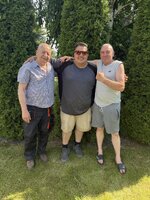
Lukasz and I
I know it has been a while but I recently became a very small part in a story I think you may find interesting so I wanted to share. It was the culmination of around 5 years of 'on again/off again' searching just depending on what was going on in my life and some dead ends but it reached the right place in June 2026 after all those years. Just a warning the images that are included are history but heavy so if it is not something you want to see just giving a heads up and I have admittedly not been around much so maybe forum rules have changed.
In 2021, I was at a militaria meet in my home state of New Jersey. It was the first summer since COVID where things were opening up and more people were gathering. During COVID I began collecting photographs from WW2. I was collecting interesting units/vehicles from all countries and I had started becoming good at some of the basics such as identifying copies or reproduction photographs and all the nuanced things I did not realize when first getting into photography. After collecting hundreds of photographs at this point I was looking around and noticed two photographs at a table that were not typically what you see for sale in the private sale market. They showed a group of people in civilian clothes and a group of German soldiers surrounding them. In one image they were digging a ditch and in the second image they were lined up at the ditch they had dug with rifles pointed at them. A third photograph was displayed next to the set that had a group of German soldiers taking a picture together, I did not really know if this one was related but I looked at the back of all the photographs. While I could not make out words in the older German handwriting I could make out one word that occurred on each photograph Głowno. I wasn't quite sure what it meant but I thought it was maybe a location. I immediately felt like these photographs did not belong in a private collection and another part wondered if it would be possible to figure out who was in these photographs. They had faces but no names 87 years later. Below are the photographs
Admittedly, this is my mistake but I was 24 at the time, I felt like I had come across something pretty rare so I didn't ask the seller too many questions. In retrospect it would have filled in a lot of blanks but I can't go back and change that. I purchased them, it felt very bizarre but my goal was 'maybe I can figure out what happened and give the photographs to a museum' and a lesser chance in my mind was maybe I can return these to the families.
With some help from the internet I was able to transcribe the backside of the photographs:
"Głowno September 1939, Polish Snipers dig their grave"
"Głowno September 1939, Polish Snipers before being shot to death"
Third one just gives the location of Głowno Poland September 1939"
I finally had confirmation after researching Głowno, Poland that is the described location of these executions. To my surprise, Głowno was not a very large town with around 10,000 people today. Finding descendants felt a little more attainable if they remained or were still alive/aware of the story. I reached out to Institute of National Remembrance for information and sent the images to them as I was not having much luck locally reaching out. IPN sent an automated email and I truly am not faulting them, they probably deal with so many requests that I never heard back from them. I began looking at maps of Głowno from the 1930's and 1940's paired with Google Earth to try and figure out where this may have exactly happened. Głowno is very flat and has a rail line that runs through the center of it, this gave me a starting point for where the executions happened because in the background you can clearly see a manmade embankment and the suspicion was that it was a railway embankment which all of the reserch helped confirm. While the research seemed productive it did not really bring me closer to the 'Who?' question that I was after. Here is one of the maps used Glowno 1940 MapI was nearly at 2 years with limited progress and I decided to throw a Hail Mary.
I posted the images online with only the facts such as the images themselves and what the rear of the photographs said with Głowno in the title in hopes the power of the internet would find the right person for this. I waited, three years in fact. People gave their terrible opinions on the photographs and I kept waiting. I would revisit it every so often but as I moved to a supervisor role at my job, my workload increased and it was starting to not get the attention it deserved
January 2026, I received a message where the photos were posted from Lukasz. Lukasz is a firefighter in Poland which was coincidental but the far larger part was he was the great grandson and great great grandson of Jan Bednarek and Jan Bednarek. They were killed on September 12th, 1939 in Głowno with a number of other men from the village of Ziewanice just outside Głowno. To say I was speechless is an understatement. Lukasz sent me his family tree, he took videos of the execution site that had been passed down solely by word of mouth from his family through generations and had far more information than I could of thought possible relating to these photographs. I felt confident Lukasz was who he said he was after roughly 40 emails back and forth.
From the story that was told to generations of his family (this is copy and pasted from our emails):
"It all began with the "Battle of the Bzura." On September 9-10, 1939, the Poles attacked the Germans stationed in Walewice and on the right bank of the Bzura. With each passing day, the Germans, under Polish pressure, were forced to retreat further and further towards Głowno. The front was shifting rapidly. The Germans knew they would establish their main line of defense in the town. It was during their withdrawal on September 10 or 11, 1939, that someone from the local administration came to the village headman for Ziewanice (Jan Bednarek - my great grandfather) and said that within two days heavy fighting would begin in the village and that it would be best for the residents to evacuate towards Łódź. The entire group (women, children, and men) reached the railway tracks in Zakopane. There, the group was stopped by the Germans stationed in Głowno. The men were separated from the women and children. Women and children were directed to a school building, while men were ordered to surrender all dangerous items. One of the residents (Górajek) was deaf and mute and didn't understand the order. The Germans searched them to make sure they had surrendered everything. Unfortunately, Górajek had a razor, which the Germans interpreted as an attempt to conceal for a later attack. The decision was then made to execute the entire group. The presence of a photographer may be surprising, but the Germans didn't execute them that same day, but held them in the basement of a nearby building. This suggests they were waiting for the photographer. During these three days, the Germans were pushed back by Polish heroes to the Ozorków-Stryków-Głowno line, but ultimately, there was no attempt by the Polish Army to attack Głowno, as orders from above demanded a withdrawal and march towards Warsaw."
- Jan Bednarek, age 74
- Jan Bednarek, age 46 (son)
- Józef Bartczak, age 42 (father)
- Władysław Bartczak, age 17 (son)
- Franciszek Kapusta, age 54 (father)
- Jan Kapusta, age 18 (son)
- Władysław Bednarek, age 21
- Jan Bednarek, age 27 (brother)
- Antoni Bednarek, age 31 (brother)
- Józef Olejniczak, age 30 (brother)
- Antoni Górajek, age 60
They were also held in a railway pump house overnight. Here is the pump house today, the men were held in the door around the right side in the basement:
So I had met someone whose family tree, information they knew and locations all checked out. I felt this huge sense of relief. I told Lukasz I wanted to personally deliver these photographs to him so they could be kept properly and handled however the families of the victims saw fit, it was their decision what they wanted to do with them. I did not intend the story to become as visible as it had, I simply did not want to chance shipping these photographs which were the only known photographs of many of their loved ones and possibly lose them. I could have gone for only 24 hours if it meant they got back to where they belonged.
So after some coordination this June I went over to Poland. I met Lukasz who was an incredibly kind and an incredible host who took me to all the locations associated with this event that they knew from relatives/grandparents stories growing up. After the men were executed, their bodies were exhumed in November 1939 and reburied a church outside of Ziewanice. I went to the railway pump house, I went to the execution location that they knew from years of oral history, I went to both Jan Bednarek's final resting place and lit a candle. I was able to meet grandchildren of Jan Bednarek, there is still a surviving daughter who is in her 90's but in poor health. It was truly a moving experience that there are not really proper words for. The local news asked to interview us which has suddenly made its rounds and was picked up by a larger news station. The overarching goal is to get a monument placed where the executions took place but it requires some political channels to become involved. The minister of infrastructure has actually reached out to Lukasz offering support for getting the land and funding to build a monument.
At the end of the day, I am just grateful these men have their names back and their story back for the world to see 87 years after the fact. The story is theirs and the families, I only played a small part in bringing these images back to where they always belonged. Below are some photographs from my trip:
Lighting a candle at Jan Bednarek (father and son) resting place after exhumation
Lukasz and I