This is an interesting question I have looked into and discussed with a number of people who have expertise in the area.
Most U.S. control towers were set up to transmit on 268 KHZ for the purpose of giving landing and takeoff clearances to aircraft. So even light aircraft were equipped with receivers for the frequency range 200-400 KHZ, even if they had no transmitter. For this reason, when the USAAF adopted the SCR-274N "Command Set" receivers and transmitters early in WWII, a standard equipment set consisted of a BC-453 receiver for 190-550 KHZ, a BC-454 receiver covering 3-6 MHZ and a BC-455 for 6-9.1 MHZ, together with a couple of transmitters, enabling coverage of both the AN Range as well as the standard control tower frequencies and other required military communications. This equipment required a long wire antenna, typically sting back to the top of the tail.
When the USAAF got to Europe, it found that the RAF had adopted VHF for fighter aircraft communications, using a crystal controlled set known as the TR1143. The Americans had to be compatible with the British when it came to fighters, and VHF gave far superior short range communications anyway, so the U.S. built the British set as the SCR-522, and adopted it as the standard radio for fighters, at least in Europe.
VHF was a big advancement but it caused a bit of a dilemma, especially for fighters operating in the U.S., which had to still use the AN Range for navigation. Fighters flown in the U.S., at least, had to have the low frequency receiving capability. Problem was, the SCR-522, while no more bulky than the SCR-274N receivers, transmitters, and modulator, still took up virtually all of the available room in the aircraft. Also, the fighters deployed to Europe would not necessarily require the low frequency capability, so an easy add-on capability was desirable to keep things as standard as possible.
The answer to this problem were the Detrola Model 438 and the BC-1206.
Both the Detrola and the BC-1206 were designed to operate directly from 24VDC, without a dynamotor, and to be set up so that they could fit into a standard aircraft 3 inch instrument panel hole. They were small enough to be mounted directly in the cockpit with no more than a power lead and an antenna connection. Using their headphone jack, the sets could be plugged directly into the same audio circuit used by the SCR-522, so switching between radios was not required. They could be installed or removed within minutes without affecting the VHF installation.
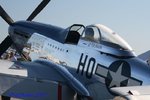
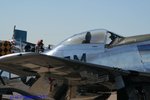
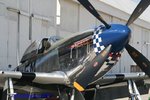
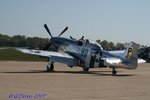
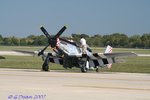
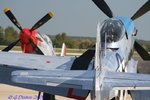
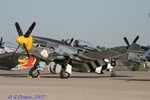
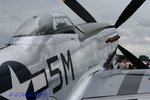
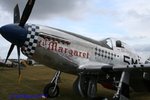
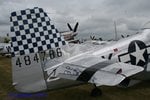
The Detrola went into the later model P-38, P-51, P-47, and some P-63's, fitting right into the cockpit, possible because the remarkably small receivers were only about twice the size of the control boxes used for the larger radios. The P-51 and P-47 had the little set right next to the pilot's seat, facing upward at an angle, while on the P-38 it was to the right of the pilot's seat, almost resting on the floor, facing up. On the P-61 it was in a rather strange installation behind pilot's right shoulder, the dial facing forward. The P-63 manual I have describes the Detrola as a "portable" installation, even though it is bolted down under the main radio panel at the bottom of the instrument panel and the P-38 manual says the Detrola "may still be installed." Presumably this indicates the possibility that the set was yanked out when the aircraft was deployed overseas. Interestingly enough, none of these installations used the set's ability to be installed in an instrument panel hole. All installations used long wire antennas; on the P-51D, the Detrola antenna is the long wire coming through the hole in the top of the bubble canopy and stringing back to the tail. The AN-104 mast that was the actual antenna used for the SCR-522 also was used to hold the long wire antenna and was insulated from the wire antenna.
In Europe, while US fighters did not use the LF band for communication but we do know they used radio beacons associated with their home fields for navigation. So at least some of the P-51's and P-47's appear to have been equipped with the Detrola/BC-1206 for that purpose, along with a long wire antenna.