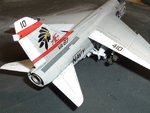
I had seen this thread before but bypassed it before. Now, taking the time to red it. WOW! Having read the mentioned articles, I am in agreement with the referenced opinions. This is especially true of modern jets. I spent 17 years working on F-4's. Everything from c models, d, e, g, and recce. Working on them in different types of climate too, high humidity of the Philippines, dry desert of Arizona, cold nasty Korea. In the recent SM magazine, there was an excellent 2 part article about super detailing a F-4E. The modeler was very good about correcting some of the discrepancies with the kit, which by the way I have not built. But then he shaded every single panel on the aircraft??? Sure there are panels that had a lot more handling by the crew chief than others. I say the crew chief, because he/she were the only ones removing and reinstalling the panels. If he/she was lucky, the specialist would help too. To have the amount of 'shading' that this aircraft depicted, it would have to have been flying through mud and leaked from every single hydraulic line and fitting in the airframe. That's not the case in real life.
Even though it's been 20 years since I worked on one, I have never seen an aircraft that looked that bad in real life. Sure if you stood about two feet from the aircraft, you would see the demarcation between the different panels. But that's only because your so close and not because it's dirty.
Something most folks don't know is that the most replaced items were the screws holding the panel on. There was no requirement to paint the screw heads when you reinstalled a panel. Most panels had a couple bad nut plates or stripped screws that would cause a new screw to be installed or you lost a few. Believe me, a shiny new screw really stood out. If your bird had come out of the paint barn recently, or sometimes if you asked nicely, the paint shop folks would give you a small container of the type paint you needed and a disposable brush and let you take care of the screw touch ups.
Even though there are no overlapping panels or welded panels together except in the rear titanium panels, the lines between panels are nearly invisible from a distance of 20 or 30 feet. Not to take away the modelers skill or anything, but if your going to super detail an aircraft, don't be lulled into a fad, but then again, it's your model, do what you want. But if it's supposed to be an accurate representation for others or for display, make sure it's right. Working from photos taken at a distance of 2 or 3 feet will show all kinds of little details and make it look like every panel line popped out at you.
This is my opinion and certainly not to take anything from anyone else's exceptional work, most certainly not the guy who did the F-4.
As a side note I have also worked along other services and county's aircraft during exercises and during Desert Storm. The only time I have seen an modern aircraft that more dirty looking, was a USN F-4J that came by for a refueling stop on it's way to a depot for major overhaul.. It had been recently flown off the carrier from a long deployment. That aircraft looked terrible. It hadn't been washed or even wiped down in ages. I know the guys at sea don't have nearly any of the advantages of land based guys, ie regular washes, more time to take care of appearances and what not, but this aircraft was a disgrace to every plane captain in the navy.
One more thing and I'll shut up. In all the time I was in the USAF on aircraft, when we had a TDY for an exercise or competition, like William Tell, Red Flag and Green Flag, the wing king would come out about a week before to look at the a/c that were going. If they didn't look the part ie clean as a whistle, they were towed to the paint hanger and had quick touch ups done. Some stuff could be done on the line before they left. God help the crew chief that let his a/c look bad during a TDY. The same thing was done when we had a a/c going cross country. It had to look good and that included the a/c forms and binder all had to be brand new and spotless. Of course most of the crew chiefs would maintain their a/c in pretty good shape. It was a matter of pride.