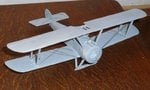
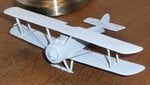
Stringbags gives me a headache! WWI aircraft...

Ad: This forum contains affiliate links to products on Amazon and eBay. More information in Terms and rules

No, it wouldn't take more than half an hour......before I hit it with a lump hammer in sheer frustration!
Glenn, surprised about the lack of cockpit detail on the Gladiator kit. That was one of the outstanding fearures (for the time) on the original Inpact kit. I saw a recent build of the Lindbergh kit, and it had the basic cockpit detail included.
 
Glenn, surprised about the lack of cockpit detail on the Gladiator kit. That was one of the outstanding fearures (for the time) on the original Inpact kit. I saw a recent build of the Lindbergh kit, and it had the basic cockpit detail included.

Terry I stand corrected. I just looked around the pilot in my gladiator and it did have a nice little panel and a stick and probably a seat with the little pilots a*s glued into it. I must hade been thinking of one of the other biplanes I built at the time when I wrote that.:oops:
 
My current challenge is a 1:48th Camel, and I'm getting to the point now where I'll need to start planning the rigging. Looking at close up photos the attachment points are at the base of the struts rather than the wings themselvels so I should be able to micro drill the struts, then attach them to the lower wing/fuselage, and leave the top wing off completely to rig the whole thing. I've got a reel of nylon mending thread to do the job which will need painting metallic when fitted. I'll post some photos once I get started.
 
I finished a Revell 1/72 Nieuport a while ago and I used sewing thread to "rig" the plane. I know the thread is probably slightly out of scale but it give a little more life to the plane. This is the first WWI plane I have ever built and I really had fun with the rigging. I just started working on the Revell 1/72 Fokker DR.1. It has rigging but not as much as the Nieuport.

IMG_2804.jpg
 
Nice job, especially for a 'first' on biplanes ! Try the 'invisible' thread which I think has been mentioned here.


Thanks. I've tried looking for the "invisble" link but could nto find anything. Though, I do like the idea of using stretched sprue. Can't believe I did not think of it before!
 
The 'invisible' mending thread is used in the same way as any other thread, but has the advantage of being able to taughten, and hold position virtually immediately with a small drop of 'superglue'. How to attach is the preference of the modeller. The thread should be available from most outlets selling sewing items etc.
 
I've now got well into rigging my Camel fighter, and as with anything new it's learning on the job (with a steep learning curve), so have been trying different techniques and settling on what I find works the best for me, and making reasonable progress (better than expected).

For thread types, I've learned before never to use cotton or similar textile threads as they have fibres protruding along their length, so have purchased a reel of nylon invisible mending thread as mentioned above, and a reel of reasonably fine black nylon thread (available at Hobbycraft or Dunelm Mills (in the UK)). The invisible thread is so fine I thought I'd keep it for antenna wires on WWII aircraft and decided to use the slightly thicker but still very fine black nylon thread.

Applying to the aircraft is a whole science in itself !!! I thought I'd build up the fuselage and lower wing with struts and leave the top wing off, to gain easy access to add the wing bracing wires, so added a few strands from the lower wing to the top of the struts quite successfully, then tried the top wing for size and as they were very slightly out of alignment, the bracing wires lost a bit of their tension and sagged slightly, so it was back to the drawing board. I soon decided that I had no option but to fully build it up including the top wing to form the complete main structure, and start again with the rigging.

I found the best method to attach the rigging at the wing points (base of the struts) was to put a small drop of glue using the Humbrol fine applicator at the attachment points and a tiny drop at the end of the thread, touched the two together and pushed into place with a needle pointed tool, cut the other end off the reel with excess length, and left to set, then repeated for other bits of the rigging while the first end dried. After leaving it for a bit I went back to the first piece attached at one end and pulled the other end of the thread taught and snipped off the excess so it was exactly the correct length, and placed a tiny drop of glue again at the end of the thread and at the upper base of the strut, and pulled the thread up into position with tweezers, then pulled tight in using the needle ended tool, and held for about 30 seconds while it set (occasional rotating the needle tool so it didn't bond to anything), then removed the needle tool away and the rigging piece was left nice and taught.

The good thing about this method is it is fairly quick and a lot of rigging pieces can be done a in a fairly short time (around a two hour session)

Ultra%20Clay%20Pick.jpg
humbrol-igla.jpg.thumb_200x160.jpg


In other positions such as the tail and undercarriage bracing, it was easy to drill tiny holes by hand with a micro drill, thread through and apply tiny drop of glue at each point.

It's nearing completion of the rigging now (thankfully much more rapidly than expected), so will try to get some photos posted soon.

Others of you may do it completely different to the method I've evolved as described above, but I thought I'd just share my findings having tried it for myself.
 
Last edited:
Here's progress so far, all bracing rigging is done, but still the external control wires to do.

I tightened a couple up between the main wings which had sagged slightley, and still need to tighten the tail bracing up.

I noticed they are very sensitive to sagging even when picking the model up as just slight flexing of the wings under its own weight is enough to cause slight deflection and sagging of the bracing.
 

Attachments

  • Rigging 1.JPG
    Rigging 1.JPG
    73.4 KB · Views: 131
  • Rigging 2.JPG
    Rigging 2.JPG
    78.8 KB · Views: 135
Last edited:
Great job. Try gioving them a gentle pass with a hair drier - the heat might then taughten them. It normally works with invisible thread.

Thanks for this tip.

I just tried it and the threads all taughtened, it was like magic as all sagging disapeared and tightened before my eyes.

The only problem is after 10 minutes I presume it has cooled, and they've gone back to as they were before. Is there another tip that might set them in that state permanently?
 
Yes, although it depends to an extent on the original taughtness of the lines. If they're fairly taught, to the point of not quite causing warping, then a pass with the hair drier, then immediately another pass on 'Cold' setting, that normally solves it.
 

Users who are viewing this thread

Back