During forty years of experience with firearms both in and out of the military, you are the first person I have ever encountered that described John Browning's .50 caliber with the word "weak".
Expense, redundancy, ease of maintenance, rapid fire, ammunition capacity, and most importantly sufficient power are qualities to be balanced against raw power.
From "Flying Guns, World War II" page 98 referring to the BoB
"In a comparison between the British fighters and the Bf109E, the striking difference in ammunition supply must be noted. The British fighters carried 300 rounds for each of their eight machine-guns, enough for sixteen seconds of fire. The Messerschmitt's 20 mm cannon were restricted to 60-round drums, a supply for seven seconds. On the other hand it carried 1,000 rounds for each of the two rifle-calibre guns (this was reduced to 500 if an engine cannon was installed), and because the MG 17 was not particularly fast-firing, and synchronised as well, this supply was good for about a minute of fire! Because the cannon were far more destructive weapons that the machine-guns, the effectiveness as a fighter of the Bf 109 decreased sharply when they ran out of ammunition: but the German pilot still had some guns to defend himself with."
"Clearly the low-velocity, low-rate-of-fire MG-FF was more suitable for dealing with bombers than with fighters, and the RAF would probably have benefited more from such a gun than the Luftwaffe did. Aside from this weapon and the very limited use of the Hispano by the RAF, both sides relied (too much) on rifle-calibre weapons. It has been claimed that Goring later said that the Luftwaffe could have won the battle if it had had the Browning .50 in.; even if he indeed said so he was probably wrong. But there was an awareness, on both sides, that the armament was not what it should have been. That there was an alternative was demonstrated in Belgium, where Avions Fairey completed two or three license-built Hurricanes with four 12.65 mm FN-Browning (.50 in. M2) guns before the country was overrun." (bold add for emphasis by Lighthunmust)
Of course merely having the .50 would not have changed the outcome of the Battle of Britain! The Americans were not the only nation thinking four .50s was the way to go for balance of power and firing time. Fabrique Nationale could have easily provided rifle caliber guns. Perhaps if the Luftwaffe's single engine fighters carried heavy machineguns with lots of ammunition and had the fuel efficiency of a Mustang for longer patrol times to shoot down the escort fighters, it would have allowed the twin engined bomber destroyers to be more effective. The .50 caliber MG with sufficient ammunition supply was a very good compromise of firing time and power for shooting down any WW2 aircraft. It was not weak, it was sufficient in power and efficient in all other areas of performance.



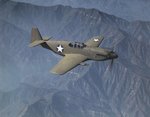
 Did the P-51B/C/D have those guns? and the P-47 also had heavy cannons?


