.
All this movement of men and resources ....
War is all about moving men and resources! 
converting of the differing gauge of track ...converting North American equipment to run on the decided gauge even todat these countries all use differnet gauges.
None of the N. American equiptment would be converted, only the Nigerian Sudan rails would be re-guaged
Pb it's not that difficult to re-guage railway lines,
the Germans averaged 1,500 track-miles re-guaged per month of Soviet lines in 1941-1942. The Nigerian Sudan system would need about 850 miles re-guaged in each country, over 3 months that's only 600 miles per month. At the same time the
Germans also built or re-built over 650 track-miles of each month in the USSR, the difference is that the Soviets also destroyed almost all of the bridges, water tower, coal stations, railway infastructure etc. For the British all of that would still be in place on the Nigerian Sudan systems.
The Nigerian system is not compatable today with any of it's neigbours route if they even have a rail system . Every country you want to build a railway through like Chad, Mali, CAR all have one thing in common no water.
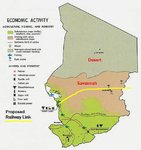
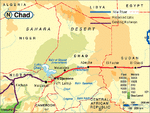
?? Check my map, the route would only go through Nigeria, Chad Sudan, nowhere near Mali or C.A.R. All railways transport water in tanks to fill the water towers, in 1942-1943 the US UK expanded the Persian system's capacity by over 3000% from Basra - Tabriz, and there is no water there either.
Use google earth and check out your route.
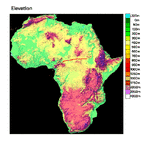
I did, its all mainly flat, hot, semi-arid, savannah not much difference from the northern part of Nevada (Union Pacific route from Reno-salt Lake) except its hotter.
I've posted the terrain map below.
Also check out the Alaska Highway and it was built on the North American continent.
I've driven on the Alaska Highway, thanks, through Rocky Mountains of nothern B.C., it is about as different from the "Chad rail-link" as possible. Unlike the African grasslands,
the Alaska highway was forested the whole way, needing tree cutting almost every mile. The Alaska route was very rugged, meaning it had to cross ridges, vallys and many rivers. In addition the winter freeze destroys bridges roadbeds. It was also far away from populated areas transport meaning that men supplies would often have to be flown in. The African route does not have these problems.
In short and in the real world it would be a total waste of valuable resources and men.
The men and resources are already in place suppling the Desert Army, remember that after the long "round the Cape" voyage the supplies would have to be unloaded at over-crowded Red Sea or Palestine ports, and then re-loaded onto railway cars for transport to the front. This was because after the disasterous Greek expedition the Desert Army had lost most of its truck transport.
If the Axis had heavily attacked Allied shipping in the Indian Ocean in 1941 the rail link would allow the Allies to keep fighting, otherwise they would have to abandon Africa, Arabia India as they would not have any ships left supply them.
In the "Real World" the Allies were barely able to survive anyways, and with a very limited (Indian Ocean) Axis submarine offensive. If the Japanese had sent their subs against Allied ports the
British would be unable to supply their Empire and would probably lose all of the colonies on the Indian Ocean.