The improved LaGG-3 (e.g., Batch 66) in Sepember, 1943 at the end of production was not much better than the Yak-1b in November, 1942. LaGGs of the last batches were manufactured in Tbilisi (State Aviation Plant No.31), where the manufacturing culture was remarkably worse than in Gor'ky (State Aviation Plant No.21) even for the Soviet quality level.
LaGG-3 / Batch 66 had fairly good combat outcomes, from what I've read. Yak-1B was also a good fighter.
The real breakthrough was the M-71 - it allowed to produce I-185 and Su-6/Su-8 which were far superior to Yak/La and Il-2/-10 respectively. Unfortunately the design bureau was ordered to concentrate all efforts on the M-82 only.
M-82 was an excellent engine by world standards, and the I-185 and Su-6 look interesting on paper, they weren't used in the war so I don't see the point.
Pe-2 was rather far overrated. Seems, that you don't read what the other write here. Pe-2 was mostly used as a level bomber with a typical bomb loading of 600 kg, dive brakes were frequently dismounted. Only few Pe-2 regiments had pilots, which were sufficiently trained for dive bombing. Moreover, Pe-2 required well-trained pilots because of specific aerodynamic features of its wing airfoil on take-off/landing. It is still disputable, whether the choice of Pe-2 instead of SPB or even Ar-2 was optimal for the Soviets.
Whether or not all pilots used it as a dive bomber isn't really relevant to the overall merits of the design. One of the features of the Pe-2 was that it was quite versatile, even in the heavy fighter / night fighter role as the Pe 3. But clearly some units
were used as dive bombers and with particular success in that role.
Pe-2 as a dive bomber was probably more accurate than the Ju-88.
There is an agreement, that the efficiency of the Il-2 was not so high as it was described by the Soviet propaganda - you can read books by Oleg Rastrenin who is the most prominent historian of the Il'yushin ground attack planes (and Soviet CAS aircraft as well) to date. Guns (both 23-mm VYa or 37-mm ShFK-37/NS-37) were not efficient against tanks.
There is some truth in that the guns couldn't automatically knock out heavier tanks, but this tends to be very overstated. The assumption here seems to be that all German tanks were tigers, and all armored vehicles were large tanks. Many German tanks up to 1943 were fairly lightly armored, especially on the sides and rear, and most of the vehicles in an armored force were not in fact medium or heavy tanks. All armored vehicles in WW2 had relatively thin top armor. Or none.
Panzerjäger I (mobile anti-tank gun) had armor of 6-14.5mm (~200 produced through 1941)
Marder II (mobile anti-tank gun) had armor 14.5mm sides and rear, 35mm front, and an open top (~500 produced in 1942)
Marder III (mobile anti-tank gun) had armor from 10mm (sides and rear) -50mm front, and an open top. (~400 produced in 1942)
Pz II (light tank) had 5-15mm armor (~500 produced 1941-1942)
Grille (self propelled 15cm field gun), had 10-15mm armor (225 produced in 1943)
Pz 38 (t) (light tank) 8mm sides, 30mm front (~1300 produced by 1943)
Pz III Ausf C (medium tank) 15mm armor all around
Pz III Ausf D-G (medium tank) 30mm armor all around (~2,200 produced by 1943)
Pz III Ausf J (medium tank) 50mm armor all around (~2,000 produced by 1943)
Pz IV up to E (medium tank) 15mm sides, 30mm front (~600 produced by early 1942)
Pz IV F1 (medium tank) 20-30mm sides and rear, 50mm front
Pz IV F2 (medium tank) 20-30mm sides and rear, 50mm front (first appear in 1942, 870 produced in that year)
Pz IV G-J (medium tank) 20-38mm sides and rear, 50-80mm front
StuGG III (assault gun) had 16mm sides - 50 or 80mm front
Panthers aren't available until 1943
Tiger I available in very small numbers in 1942, a few more in 1943, only 1300 produced in the whole war. Admittedly, a Tiger I would be pretty safe from guns of an Il-2. Same for a Tiger II needless to say.
Same for some of the later self-propelled guns and tank destroyers, but by the time they appeared the Germans were long past winning any battles, either in the sky or on the ground.
Then lets remember that most of the forces in an armored German column would be much lighter armored and unarmored vehicles, like:
A dizzying array of light armored, open top halftracks (5.5-14.5mm armor)
A wide range of light armored cars (also often open topped) for example Sd.Kfz. 231 "acht rad" had 8-15mm armor.
Lightly armored, or unarmored self propelled AAA guns (always open topped), and
Self-propelled artillery vehicles. Which were also usually open topped and lightly armored. For example Wespe has 5mm armor (sides), and 30mm (front) and an open top.
And then a
lot of trucks, kubelwagons and other light vehicles, and for the German armed forces, many (as in thousands) of horse drawn carts and wagons.
The 23mm guns (VYa-23) on a Sturmovik shot 190 gram projectile at a velocity of 970 m/s. could penetrate 25mm of armor at 400m with a rate of fire of 650 rpm
The 37mm gun (Sh 37) shot a 730 gram shell 880 m/s and could penetrate 37mm of armor, with a rate of fire of 170 rpm
So basically
all of the light armored vehicles, light tanks, self propelled artillery guns, halftracks, and AA guns in a German armored unit could be pretty much instantly killed by hits from the 23mm, let alone the 37mm gun. Most medium tanks were still vulnerable on the sides, and even the heavy tanks and assault guns could get their wheels and tracks blown off by either of those guns, leaving them stranded and vulnerable (at which point the crew would often bail out).
I don't think those guns were useless against armor, and obviously the Soviet armed forces didn't either.
Even totally obsolete I-153s and I-16s (for instance, they destroyed bridge with an oil pipe from dive in Romania in 1941 being launched from the TB-3 bomber) were sometimes more effective - at least their losses were significantly lower.
I-153s and I-16s played a similar role to
Hs 123 (still in use at Stalingrad and and Kursk), and to many other light observation and CAS aircraft used by the Western forces all the way through WW2, and into Korea, Vietnam and in many other conflicts. That is a particular niche. The parasite I-16 fighters being used in Ploesti were an interesting experiment that was not repeated, largely due to the slow speed and vulnerability of the TB-3.
It's a good story though.
But I doubt, that Pe-2s were considerably more effective against AA (even more effective at all) taking into account that they were primarily used as level bombers. In contrary, the AA suppression was a typical task for Il-2/-10 throughout the war.
Quite often Pe-2 dive bombers were used in this role. It was a long war involving many, many aircraft. For example:
Quite illustrative is the sinking of the anti-aircraft cruiser Niobe (converted from Dutch protected cruiser Gelderland taken over by the Germans) in the port of Kotka on July 16, 1944. The Soviets were sure that they found the Finnish coastal defense ship Väinämöinen, which they hunted during the whole war. The first strike (30 Pe-2s from dive) gave zero result - all 70 bombs did not hit the target. It was necessary to increase significantly the strike group - finally it counted 131 or 132 (!!!) airplanes including escort fighters. 23 Il-2s (not Pe-2s!!!) were used to suppress AA artillery, then 11 Pe-2s hit the ship with four 250kg-bombs
I'd cite this as proof of the dive bombing accuracy of the Pe-2. Four hits on a ship considerably smaller than an aircraft carrier from 11 dive bombers is
excellent bombing accuracy in WW2. Few Stuka raids had superior accuracy to that.
, but did not sink it - the ship guns were still firing.
Whether the ship sank or not is kind of irrelevant to bombing accuracy. Larger armored warships usually required larger than 250 kg bombs, but four hits actually did some damage.
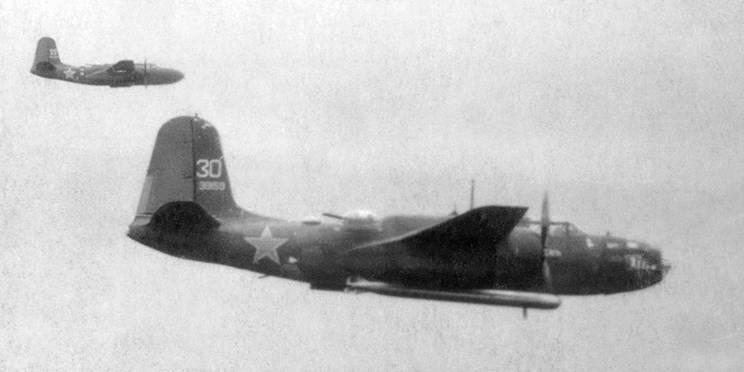
The Niobe was finally sunk only by 1000kg bombs from four A-20Gs (one of them was shot down) by skip-bombing. And it was one of the best Pe-2 regiments (12 GBAP of the Baltic Fleet Air Arm, commander V.I.Rakov) trained for dive bombing in the Soviet Air Forces...
Clichès, surely...
They may have liked the A-20s, but they suffered very high losses with them. More than with the Pe-2s



 vvsairwar.com


