Light fighters alternatives, 1935-1945 (5 Viewers)

How heavy were the heavy fighters? Say, in 1943?
This comes from my collection of Profile Publications. For comparison, a P47D-22RE weighed 9,900lb empty, 13,500lb normally loaded, and 15,000lb maximum loaded. The engine had 2,300HP.

AircraftEmpty weightLoaded weightPower
Messerschmitt Bf 110G-411,220 lb20,700 lb2X 1,475 HP
Messerschmitt Me 410A-1/U213,550 lb23,500 lb2X 1,750 HP
Bristol Beaufighter Mk I13,800 lb21,000 lb2X 1,400 HP
 
While the ship has sailed in this thread on Hosho (pun intended); IJN's 1st carrier couldn't fit Claude's in its hanger without modification.

As S Shortround6 alluded in his post, the reason the Mitsubishi 1MF had to have a wingspan of only 8.5m, was the forward hanger was only 9.5m wide. So, the 11m wingspan A5M isn't going to fit. It won't even fit with folding wingtips ala Zero or Seafire. You have to put a fold mid-aileron to get the Claude to be able to fit (Aichi has such a fold on the Val, so the "B" team could be assigned to make the change. Then you could fit 8 of Mitsubishi's 1st monoplane naval fighter in the forward hanger (down from 9 1MFs as the A5M is about 10% longer). How much does an additional 100kg for the wing fold hurt the Claude's performance??

I'm not sure you can fit more than 4 Nakajima Kates in the 2 level aft hanger versus 6 of the older Judy's.

A lot of work for a little CAP/reconnaissance.

There is part of me that says having 4 Rufe fighters on each of the Chitose class seaplane tenders/pair on each of the Tone CAs ready to launch for CAP would have been better bang for the buck (basically same speed, but much better armament).
 
The twin-engined Westland Whirlwinds and Lockheed P38 Lightnings were twin-engined, but small. They had good power loading, so they could mix it with regular fighters. The Messerschmitt Bf110 successfully used hit and run tactics against obsolete fighters in Poland, Norway, the low countries and France. When they went up against aircraft that could keep up with them, they lacked the manoeuverability to complete attacks, or get out of trouble. The later Messerschmitt Me410 could just about keep up with the contemporary single-seat fighters, but again, it could not manoeuvre.

Heavy fighters were successful when they performed missions that did not involve fighting single-engined fighters in clear daylight. They could carry radar for night fighting, and they could carry heavy bomb loads as fighter-bombers.

The P-38 was almost as big as the de Havilland Mosquito, though a bit lighter.

The Bf 110 and Me 210 were marginally bigger than the P-38. The Me 210 was baout the same weights, the Bf 110 was lighter.

The Wastland Whirlwind was quite a bit smaller and lighter than the P-38.
 
I am reading back through the early messages of this thread. We are having difficulties defining lightweight fighters.

From the mid-thirties to the end of WWII, the engines increased in displacement and power, and the guns got bigger and more numerous. Aircraft like the Mitsubishi A5M and the Curtis P36, developed in the thirties, used the biggest available engines, and if not (relatively) massive firepower, their armament was at least conventional. However light they were later in the war, they were conventional back in their day.

It's 1943, and the Billy Bob and Cousin Elmo aircraft company sets to work developing a lightweight fighter. In 1943, BBCE can design around the Pratt & Whitney R1830 in preference to the now available and reliable R2800. I think that less than four M2 0.5" machine guns is not a good idea. To keep the aircraft as tiny as possible, we give up high altitude performance, and range. If the aircraft is really tiny, it will have good acceleration and climb.
Returning to this premise.
Billy Bob and Cousin Elmo have bit of problem in 1943, it is sort of slump year in R-1830 development so BB and CE are faced with the choice of two 1941 R-1830 engines or building prototypes and hoping the 1944/45 R-1830s show up a bit early. I am ruling out the trubo R-1830s to keep things simple (no light-weight P-43s) but add them in if you wish.
You have the two speed R-1830 of 1200hp at sea level which sounds OK, and it's 1495lb weight. Problem is that has 1050hp at 13,100ft and that is about as good as it gets without major supercharger work AND improved cooling (new fins or aluminum cooling muff on the 1944 engines).
You have the two stage R-1830 with 1200hp at sea level and 1000hp at 19,000ft in high gear at 1560lbs plus the intercooler installation. It does not keep the plane as tiny as possible.
The already mentioned Swedish J 22 is a very good model as to what is possible, also shows a few of the problems.
6250lbs is light? Quite possibly. BB & CE may have the option to use normal Aluminum construction and either save weight to increase strength? or bit of both? 6 G loading would not be acceptable to the US. J 22 also used the retract into fuselage landing gear with narrow track, acceptable to the US gov or needs wider track and more weight?
Better fuel only helps somewhat. When the R-1830s got better fuel they rarely increase the power, what they did was increase the height at which a given power level could be used. Like 1200hp could be used at 4900ft instead of 3700ft. There may have been a cooling problem?
That is with existing historical engines. There were some 1350hp R-1830s that showed up in 1944-45 but they used new cylinders with aluminum cooling muffs, a slightly modified supercharger and plain bearings that allowed for 2800rpm instead of 2700rpm. How much of an improvement they had at high altitude is subject to question. The 1350hp was limited to 3000ft at 2800rpm while the older engines could make 1200hp 4900ft. the new engine would be down to about 1300hp at 5000ft. The American radials never got WEP unless (R-2800s) they got water injection. Perhaps a better supercharger was needed?
What can BB&CE do as sort of a parallel development for a light weight fighter?
And is 355-365 mph at 12,000ft going to interest the US (or Britian or other allied nation) in 1943 for delivery in 1944?
The US was a tough market to sell in, by late 1943 there was no real aluminum shortage, and they didn't know what to do with P-39s and P-40s rolling off the assembly lines.
P-39 & P-40 production lines were already built/equipped and had trained workers. Setting up a new production line for BB&CE's aircraft was not going to save much money unless they built a lot of them.
The J 22 is claiming a useful load of about 1800lbs.
A P-40L is claiming a useful load of 1635lbs. and that is four guns, 201rpg and 120 US gallons (454liters) of fuel. US figured armor/bp glass and radios into the empty weight. I don't know what the Swedes did.
 
What can BB&CE do as sort of a parallel development for a light weight fighter?
And is 355-365 mph at 12,000ft going to interest the US (or Britian or other allied nation) in 1943 for delivery in 1944?
The US was a tough market to sell in, by late 1943 there was no real aluminum shortage, and they didn't know what to do with P-39s and P-40s rolling off the assembly lines.

I see no reson why would anyone in the West be thinking about a fighter powered by the 4th league engine.
If the respective air forces want a light fighter for 1943-44, something powered by a V-1710 or the 1-stage Merlin would've ticked most of the boxes, including the high performance requirement, and not be a way to the easy death of the Allied pilots.

tl;dr - the 'western' LF of 1943-44 should've been shaped like the Macchi or Yak fighter of 1942-44, not like a cropped Zero/Oscar
 
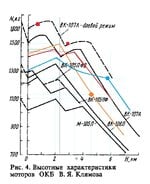
FWIW, a crude chart representing different engines, power vs. altitude.

(click on it)

12es.jpg

The base chart is for different Klimov engines, with the 105 in different versions maxing to just under 1050 HP at 4 km. Try as they might, neither of the mass-produced 105s were beating this mark. The power was improving at the lower altitudes due to the improvements introduced as the war progressed. By 1944, the PF2 version is the best, and still it is behind the humble Merlin III (not on the graph) on the same fuel. It propelled the latest Yak-9s to 620 km/h, and the smaller & sleeker Yak-3 to 640+.
By the late 1944, the VK-107A was supposed to enter service, but it was very unreliable until the post-war mods made it less of a dumpster fire. Dashed is it's 'combat setting (3200 rpm + the boost required), the full line is the 'nominal setting' (3000 rpm). It was supposed to propel the Yak-9U to 700 km/h (prototype), or as low as 670 km/h (series-produced), te post-war 9P was only at 660 km/h (?? - perhaps they decided 'let's not risk it now?). The Yak-3 with the 107A was to be doing 720 km/h (again only as prototype?).

Turquoise line is that of the restricted DB 605A, that pushed the Bf109G-2 and the MC.205 to about 650 km/h. By late 1943 the engine was fully-rated, for another 100 HP at medium altitudes.
Red line is the Merlin 20 series (link), max boost of +14 psi, and the red squares are for the even greater boost. 1-stage Merlins were pushing the full-size Spitfires to 400 mph (unarmed Spitfire III?) and to 385 mp/h (Spitfire V with the much improved fit & finish and some nip & tuck, but still with the bad carb, fixed tailwheel and without the wheel well covers).
Orange box & line is for the V-1710 with the 9.60:1 superchargers, like what a P-40N might have, and the P-39N/M will have it's sibling behind the pilot; 1125 HP at 15000 ft. Such P-39s were good for ~385 mph; Bell's charts show above 400 mph, but I don't believe them very much.
 
I agree with you. Just trying to point out the limitations of "light" fighters.
It comes down to, quite literally, what do we want to leave out?

The R-1830 is not much lighter than the V-1710 once you figure in the radiator/coolant.
To shift to an Allison powered "light fighter" study and using figures from P-40N-25 just for the engine we are looking at
335lbs..................engine section (mount and cowling)
1340lbs...............engine
92lbs....................engine accessories (pumps, generator, etc)
29lbs....................engine controls
417lbs.................propeller
45lbs....................starter/s
235lbs..................cooling system (and this is the aluminum radiator)
92lbs....................oil system
2585lbs...............not including fuel system (fuel tanks)

maybe a few lbs can be shaved off but we only have 3415lbs left for a 6000lb light fighter????
except
37lbs.................instruments
97lbs.................surface controls
150lbs..............hydraulics
203lbs..............electrical
297lbs..............armament prov (includes the armor and B/P glass, around 90-100lbs?)
59lbs.................furnishings (seat, etc)
223-130lbs......Communications (P-40N had by far the largest allowance, most P-40s were closer to the 130lb figure)
973lbs sub total

3558lbs without airframe, armament, fuel or fuel tanks or pilot.
And we only have 2442lbs left for all that "stuff" if we want a 6000lb limit.
maybe we can shave some control linkage, hydraulics and electrical and if we use only 4 guns instead of 6 we can get rid of some of the brackets and ammo boxes.
314lbs.......................four .50 cal gun installation
240lbs.......................800rounds .50 cal ammo.
600lbs.......................100 US gallons of fuel
60lbs..........................oil
180lbs........................pilot
1394lbs......................disposable load

leaves 1048lbs for the airframe and landing gear.

The Yak-3 is carrying about 120lbs less gun and about 80lbs less ammo. American .50s are heavy.
Yak-3 uses pneumatic systems for flaps, landing gear and brakes. Lighter than electric or hydraulic.
Yak-3 held about 100 US gallons of fuel. Weight of tanks and protection???

If the Allison "lite" gets down to around 6000lbs maybe we can make the landing gear only 2/3rds as heavy as P-40?
Basically, I do not see any way for the Americans to build a 6000lb fighter without changing a bunch of things from the American standard way of doing things. I mean standard American accessories, either electric or hydraulic. Going below a standard US radio set (which got heavier and more capable as the war went on), Using a non-standard US propeller.
Standard G loading limit/standards and so on.
The P-40N had an 1130lb wing, yes we can cut it but we have to cut it enough to make the fuselage, tail and landing gear out of the saved weight. ;)
 
Last edited:

Users who are viewing this thread

Back