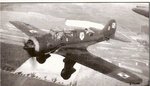
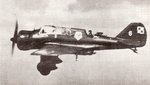
Most of these were destroyed on the ground and never really saw much active combat, and photos show very little wear and tear (except the shot down and destroyed examples... of which there were many). Thanks for your comment.
This is nonsense. The Karaśes of the Bomber Brigade flew extensive missions during the September Campaign carrying out at least 15 major bombing raids against Germany's armour concentrations. Not until the 14th September did the Luftwaffe finally locate an active Polish airfield and destroy any Karaśes on the ground.
First deliveries of the Karaś B commenced in the autumn of 1936, starting with the eskadras of the 1st Air Regiment. By the middle of the following year several Karaś eskadras, with a statutory strength of ten aircraft each, reached full combat readiness and participated in various military exercises. By early 1938 fifteen Karaś eskadras were formed and deliveries of 200 P.23Bs against the original order were approaching completion. Surplus in the Aviation Department's budget for the year ending in the winter of 1937-8 permitted the purchase of an addition ten machines, bringing the total to 210. Due to wear and tear in extensive exercises conducted in realistic field conditions and withdrawal of some machines for routine maintenance, reserves were quite insufficient to keep the units going at full operational strength and an average of only seven or eight P.23Bs per eskadra were serviceable at any given time.
To resolve the situation, during the reorganisation of the air force in 1938 it was decided to disband three Karaś eskadras; two of the 1st (Warsaw) and one of the 3rd (Poznań) Air Regiments. The aircraft withdrawn from these units permitted the twelve remaining eskadras to operate at full strength and keep a marginal reserve of equipment.
In the spring of 1939 the first-line elements of the Lotnictwo Wojskowe (Military Aviation) were regrouped to meet anticipated combat demands of the Polish High Command. Five Karaś eskadras, 21, 22, 55, 64 and 65, joined four Łoś eskadras to form the Brygada Bombowa (Bomber Brigade sometimes called the Independent Bomber Brigade), an independent formation under the direct orders of .C.inC. Polish Armed Forces. The remaining Karaś eskadras were attached, one each, to the seven land armies; 31 to Army Kraków, 31 to Army Karpaty, 32 to Army Łódż, 34 to Army Poznań, 41 to Army Modlin, 42 to Army Pomorze and 51 to Independent Operational Group Narew; these units were completely subordinate to the armies' commands, their task being reconnaissance on the armies' behalf.
On the night 23rd August 1939 mobilization of the LW was announced. The Air Regiments were disbanded, replaced by air bases. Between August 27th and 31st 1939, almost all eskadras were moved from their peace-time bases to secret combat airfields, first to emergency landing grounds and then to their secret operational airfields. Once the move was completed, the eskadras camouflaged their aircraft and COs reported combat readiness to their new superiors. Most units within the Brygada Bombowa were given new identities. The 21st, 22nd, 64th, and 65th Eskadras now became the 1st, 2nd, 4th and 5th Eskadras. 55 Eskadra ws renamed 55 Samodzielna Eskadra Bombowa (55th Independent Bomber Flight, Bomber Brigade).
On 1st September 1939 the LW had a total 224 Karaś aircraft. Combat units had 114 aircraft of which the Brygada Bombowa had 50 and army assigned units 64. Ten Karaśes were included in the equipment reserve. Training establishments had a total of 45 machines (25 P.23A and 20 P.23B), and a further 55 (10 P.23A and 45 P.23B) were undergoing overhauls and repairs. In addition, on 3rd September 41 Eskadra obtained five P.43Bs built for Bulgaria and operated them alongside their P.23Bs for the rest of the September Campaign.
Despite their obsolescence, slow speed and limited lifting capabilities Karaś aircraft of the Brygada Bombowa flew extensive bombing missions throughout the September Campaign. On 2nd September eighteen Karaśes of the Dyon VI/6 (64 and 65 Eskadras) made the first concentrated bombing attack against the Germans and inflicted heavy casualties, but only eleven aircraft returned, three of which were damaged on landing. The following day twenty-eight Karaśes from 21 22 and 55 Eskadras made three attacks on enemy armour in the Radomsko region, putting out of action 30 per cent of the enemy's vehicles. Between the 4th and 8th September some ten bombing raids were carried out, with a total of over 100 Karaśes taking part. These attacks alternated with heavy bombardments by Łoś eskadras, were directed against German armour concentrations in the Radomsko-Piotrków sector on the central front and in the Pultusk region on the northern front, and resulted in heavy losses to the German 10th Army Group's 4th Armoured Division and the "Kempf" Armoured Division; but losses to the Polish bombers mounted quickly, and the pressure could not be kept up. Although operational sorties were still being flown in mid-September, these were of small significance as the number of airworthy machines was very small.
Karaśes of the Armies' Air Force were not put to best use. Split into insignificant detached units, they were engaged mostly on reconnaissance and only occasionally on bombing attacks which were generally ineffective. The tasks given to these eskadras by various army commands were often unrealistic. The crews operating under continuous fire from German and Polish ground defences alike, did an excellent job bringing back accurate information about all major movements of the enemy but these were of limited practical value as the shattered and ill-equipped Polish armies were not in a position to counter the developing German attacks. If the seven Karaś eskadras had been employed in force on well-coordinated bombing, they could have inflicted heavy casualties and slowed down the advancing German armour.
Contrary to German propaganda claims, the LW was not destroyed on the ground in the first days of the campaign. The Karaśes fought valiantly in the Polish skies against overwhelming odds until nearly 90 per cent of them were lost in a hopeless battle. Excluding three aircraft lost in landing on bombed airfield, none of the Karaśes were destroyed on the ground until 14th September. Only on that and the following day did the Luftwaffe manage to smash nineteen Karaś aircraft on detected landing fields.
With the Russian invasion the LW evacuated to Rumania. No less than twenty-one Karaś A and B aircraft were taken with them. These were overhauled by the Rumanians and by cannibalization they obtained nineteen serviceable aircraft. Some of these had external features of both versions.