Light fighters alternatives, 1935-1945 (10 Viewers)

How heavy were the heavy fighters? Say, in 1943?
This comes from my collection of Profile Publications. For comparison, a P47D-22RE weighed 9,900lb empty, 13,500lb normally loaded, and 15,000lb maximum loaded. The engine had 2,300HP.

AircraftEmpty weightLoaded weightPower
Messerschmitt Bf 110G-411,220 lb20,700 lb2X 1,475 HP
Messerschmitt Me 410A-1/U213,550 lb23,500 lb2X 1,750 HP
Bristol Beaufighter Mk I13,800 lb21,000 lb2X 1,400 HP
 
While the ship has sailed in this thread on Hosho (pun intended); IJN's 1st carrier couldn't fit Claude's in its hanger without modification.

As S Shortround6 alluded in his post, the reason the Mitsubishi 1MF had to have a wingspan of only 8.5m, was the forward hanger was only 9.5m wide. So, the 11m wingspan A5M isn't going to fit. It won't even fit with folding wingtips ala Zero or Seafire. You have to put a fold mid-aileron to get the Claude to be able to fit (Aichi has such a fold on the Val, so the "B" team could be assigned to make the change. Then you could fit 8 of Mitsubishi's 1st monoplane naval fighter in the forward hanger (down from 9 1MFs as the A5M is about 10% longer). How much does an additional 100kg for the wing fold hurt the Claude's performance??

I'm not sure you can fit more than 4 Nakajima Kates in the 2 level aft hanger versus 6 of the older Judy's.

A lot of work for a little CAP/reconnaissance.

There is part of me that says having 4 Rufe fighters on each of the Chitose class seaplane tenders/pair on each of the Tone CAs ready to launch for CAP would have been better bang for the buck (basically same speed, but much better armament).
 
The twin-engined Westland Whirlwinds and Lockheed P38 Lightnings were twin-engined, but small. They had good power loading, so they could mix it with regular fighters. The Messerschmitt Bf110 successfully used hit and run tactics against obsolete fighters in Poland, Norway, the low countries and France. When they went up against aircraft that could keep up with them, they lacked the manoeuverability to complete attacks, or get out of trouble. The later Messerschmitt Me410 could just about keep up with the contemporary single-seat fighters, but again, it could not manoeuvre.

Heavy fighters were successful when they performed missions that did not involve fighting single-engined fighters in clear daylight. They could carry radar for night fighting, and they could carry heavy bomb loads as fighter-bombers.

The P-38 was almost as big as the de Havilland Mosquito, though a bit lighter.

The Bf 110 and Me 210 were marginally bigger than the P-38. The Me 210 was baout the same weights, the Bf 110 was lighter.

The Wastland Whirlwind was quite a bit smaller and lighter than the P-38.
 
I am reading back through the early messages of this thread. We are having difficulties defining lightweight fighters.

From the mid-thirties to the end of WWII, the engines increased in displacement and power, and the guns got bigger and more numerous. Aircraft like the Mitsubishi A5M and the Curtis P36, developed in the thirties, used the biggest available engines, and if not (relatively) massive firepower, their armament was at least conventional. However light they were later in the war, they were conventional back in their day.

It's 1943, and the Billy Bob and Cousin Elmo aircraft company sets to work developing a lightweight fighter. In 1943, BBCE can design around the Pratt & Whitney R1830 in preference to the now available and reliable R2800. I think that less than four M2 0.5" machine guns is not a good idea. To keep the aircraft as tiny as possible, we give up high altitude performance, and range. If the aircraft is really tiny, it will have good acceleration and climb.
Returning to this premise.
Billy Bob and Cousin Elmo have bit of problem in 1943, it is sort of slump year in R-1830 development so BB and CE are faced with the choice of two 1941 R-1830 engines or building prototypes and hoping the 1944/45 R-1830s show up a bit early. I am ruling out the trubo R-1830s to keep things simple (no light-weight P-43s) but add them in if you wish.
You have the two speed R-1830 of 1200hp at sea level which sounds OK, and it's 1495lb weight. Problem is that has 1050hp at 13,100ft and that is about as good as it gets without major supercharger work AND improved cooling (new fins or aluminum cooling muff on the 1944 engines).
You have the two stage R-1830 with 1200hp at sea level and 1000hp at 19,000ft in high gear at 1560lbs plus the intercooler installation. It does not keep the plane as tiny as possible.
The already mentioned Swedish J 22 is a very good model as to what is possible, also shows a few of the problems.
6250lbs is light? Quite possibly. BB & CE may have the option to use normal Aluminum construction and either save weight to increase strength? or bit of both? 6 G loading would not be acceptable to the US. J 22 also used the retract into fuselage landing gear with narrow track, acceptable to the US gov or needs wider track and more weight?
Better fuel only helps somewhat. When the R-1830s got better fuel they rarely increase the power, what they did was increase the height at which a given power level could be used. Like 1200hp could be used at 4900ft instead of 3700ft. There may have been a cooling problem?
That is with existing historical engines. There were some 1350hp R-1830s that showed up in 1944-45 but they used new cylinders with aluminum cooling muffs, a slightly modified supercharger and plain bearings that allowed for 2800rpm instead of 2700rpm. How much of an improvement they had at high altitude is subject to question. The 1350hp was limited to 3000ft at 2800rpm while the older engines could make 1200hp 4900ft. the new engine would be down to about 1300hp at 5000ft. The American radials never got WEP unless (R-2800s) they got water injection. Perhaps a better supercharger was needed?
What can BB&CE do as sort of a parallel development for a light weight fighter?
And is 355-365 mph at 12,000ft going to interest the US (or Britian or other allied nation) in 1943 for delivery in 1944?
The US was a tough market to sell in, by late 1943 there was no real aluminum shortage, and they didn't know what to do with P-39s and P-40s rolling off the assembly lines.
P-39 & P-40 production lines were already built/equipped and had trained workers. Setting up a new production line for BB&CE's aircraft was not going to save much money unless they built a lot of them.
The J 22 is claiming a useful load of about 1800lbs.
A P-40L is claiming a useful load of 1635lbs. and that is four guns, 201rpg and 120 US gallons (454liters) of fuel. US figured armor/bp glass and radios into the empty weight. I don't know what the Swedes did.
 
What can BB&CE do as sort of a parallel development for a light weight fighter?
And is 355-365 mph at 12,000ft going to interest the US (or Britian or other allied nation) in 1943 for delivery in 1944?
The US was a tough market to sell in, by late 1943 there was no real aluminum shortage, and they didn't know what to do with P-39s and P-40s rolling off the assembly lines.

I see no reson why would anyone in the West be thinking about a fighter powered by the 4th league engine.
If the respective air forces want a light fighter for 1943-44, something powered by a V-1710 or the 1-stage Merlin would've ticked most of the boxes, including the high performance requirement, and not be a way to the easy death of the Allied pilots.

tl;dr - the 'western' LF of 1943-44 should've been shaped like the Macchi or Yak fighter of 1942-44, not like a cropped Zero/Oscar
 
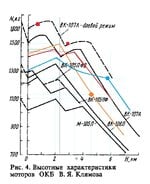
FWIW, a crude chart representing different engines, power vs. altitude.

(click on it)

12es.jpg

The base chart is for different Klimov engines, with the 105 in different versions maxing to just under 1050 HP at 4 km. Try as they might, neither of the mass-produced 105s were beating this mark. The power was improving at the lower altitudes due to the improvements introduced as the war progressed. By 1944, the PF2 version is the best, and still it is behind the humble Merlin III (not on the graph) on the same fuel. It propelled the latest Yak-9s to 620 km/h, and the smaller & sleeker Yak-3 to 640+.
By the late 1944, the VK-107A was supposed to enter service, but it was very unreliable until the post-war mods made it less of a dumpster fire. Dashed is it's 'combat setting (3200 rpm + the boost required), the full line is the 'nominal setting' (3000 rpm). It was supposed to propel the Yak-9U to 700 km/h (prototype), or as low as 670 km/h (series-produced), te post-war 9P was only at 660 km/h (?? - perhaps they decided 'let's not risk it now?). The Yak-3 with the 107A was to be doing 720 km/h (again only as prototype?).

Turquoise line is that of the restricted DB 605A, that pushed the Bf109G-2 and the MC.205 to about 650 km/h. By late 1943 the engine was fully-rated, for another 100 HP at medium altitudes.
Red line is the Merlin 20 series (link), max boost of +14 psi, and the red squares are for the even greater boost. 1-stage Merlins were pushing the full-size Spitfires to 400 mph (unarmed Spitfire III?) and to 385 mp/h (Spitfire V with the much improved fit & finish and some nip & tuck, but still with the bad carb, fixed tailwheel and without the wheel well covers).
Orange box & line is for the V-1710 with the 9.60:1 superchargers, like what a P-40N might have, and the P-39N/M will have it's sibling behind the pilot; 1125 HP at 15000 ft. Such P-39s were good for ~385 mph; Bell's charts show above 400 mph, but I don't believe them very much.
 
I agree with you. Just trying to point out the limitations of "light" fighters.
It comes down to, quite literally, what do we want to leave out?

The R-1830 is not much lighter than the V-1710 once you figure in the radiator/coolant.
To shift to an Allison powered "light fighter" study and using figures from P-40N-25 just for the engine we are looking at
335lbs..................engine section (mount and cowling)
1340lbs...............engine
92lbs....................engine accessories (pumps, generator, etc)
29lbs....................engine controls
417lbs.................propeller
45lbs....................starter/s
235lbs..................cooling system (and this is the aluminum radiator)
92lbs....................oil system
2585lbs...............not including fuel system (fuel tanks)

maybe a few lbs can be shaved off but we only have 3415lbs left for a 6000lb light fighter????
except
37lbs.................instruments
97lbs.................surface controls
150lbs..............hydraulics
203lbs..............electrical
297lbs..............armament prov (includes the armor and B/P glass, around 90-100lbs?)
59lbs.................furnishings (seat, etc)
223-130lbs......Communications (P-40N had by far the largest allowance, most P-40s were closer to the 130lb figure)
973lbs sub total

3558lbs without airframe, armament, fuel or fuel tanks or pilot.
And we only have 2442lbs left for all that "stuff" if we want a 6000lb limit.
maybe we can shave some control linkage, hydraulics and electrical and if we use only 4 guns instead of 6 we can get rid of some of the brackets and ammo boxes.
314lbs.......................four .50 cal gun installation
240lbs.......................800rounds .50 cal ammo.
600lbs.......................100 US gallons of fuel
60lbs..........................oil
180lbs........................pilot
1394lbs......................disposable load

leaves 1048lbs for the airframe and landing gear.

The Yak-3 is carrying about 120lbs less gun and about 80lbs less ammo. American .50s are heavy.
Yak-3 uses pneumatic systems for flaps, landing gear and brakes. Lighter than electric or hydraulic.
Yak-3 held about 100 US gallons of fuel. Weight of tanks and protection???

If the Allison "lite" gets down to around 6000lbs maybe we can make the landing gear only 2/3rds as heavy as P-40?
Basically, I do not see any way for the Americans to build a 6000lb fighter without changing a bunch of things from the American standard way of doing things. I mean standard American accessories, either electric or hydraulic. Going below a standard US radio set (which got heavier and more capable as the war went on), Using a non-standard US propeller.
Standard G loading limit/standards and so on.
The P-40N had an 1130lb wing, yes we can cut it but we have to cut it enough to make the fuselage, tail and landing gear out of the saved weight. ;)
 
Last edited:
The R-1830 is not much lighter than the V-1710 once you figure in the radiator/coolant.
One of the reasons we don't want it :)

If the Allison "lite" gets down to around 6000lbs maybe we can make the landing gear only 2/3rds as heavy as P-40?
Thank you for the effort to post the details.
An American light fighter powered by V-1710, let alone by V-1650-1 does not need to go down to 6000 lbs. The MC.205 with the small wing was at 7100 lbs (3200 kg) fully loaded with radio, and with not enough fuel (about 100 US gals). The VK-107A-powered Yak-3 went to almost 6600 lbs; granted, the 'normal' Yak-3 was at 6000. All 'clean' figures.
 
While the ship has sailed in this thread on Hosho (pun intended); IJN's 1st carrier couldn't fit Claude's in its hanger without modification.
As the A5M's airgroup consisted of A5M and Types 96 bombers, it did not use the elevator to move its Claudes, it used a crane to store 9 fighters in the forward hangar.

The aft hangar was larger, standing at two-storeys high, It was also apparently of irregular dimensions. Wikipedia mentions that the rear hangar measured 54 ft by 45 ft and also 96 ft 5 in by 39 ft 4 in (not sure what they mean but it seems that they are referring to the first and second floors of the hangar). It could store six bombers and six spares.

It could potentially accommo hangdate significantly more Claude fighters, whether they have folding wings or not, given its dimensions. Unfortunately, there was no loading crane as far as I can tell on the rear of the Hosho.

If the Hosho couldn't use a crane for the rear hangar, I believe they would have chosen folding wingtips for the Claude over a mid-wing fold to cut weight and solve the elevator problem. But I don't see how it's possible for the rear hangar to be too small to fit a Claude, given that its stated width is significantly larger than the Claude's wingspan.

I would guess that Wikipedia must be wrong regarding the storage of Claudes in the forward hangar or they are wrong about the dimensions of the forward hangar. I'll check out the Hosho's dimensions in a Japanese source to verify shortly.
 
An American light fighter powered by V-1710, let alone by V-1650-1 does not need to go down to 6000 lbs. The MC.205 with the small wing was at 7100 lbs (3200 kg) fully loaded with radio, and with not enough fuel (about 100 US gals). The VK-107A-powered Yak-3 went to almost 6600 lbs; granted, the 'normal' Yak-3 was at 6000. All 'clean' figures.
Quite right.

But a lot of things are "fixed" in a fighter. Once you choose an engine, all the associated extra stuff can nearly double the weight of 'dry' engine is about the same regardless of the airframe. Same for the 'cockpit' stuff and the cockpit size in the airframe. Having an extra 600lbs (10%) on a 6000lb fighter is actually closer to 20% you can play with in airframe and/or armament and/or fuel. Going to 7100-7200lbs and keeping the same engine really can buy a lot. Or you can trade up the engine to get more power.
A MK V Spit with four 20mm guns is just over 6900lbs and has crap for fuel, is it a "light fighter"? compared to a an 8500-8700lb (clean) P-40 it is and compared to a P-47 it most certainly is.
I would note that French "standard" fighters of 1940 were using HS 12Y engines that were around 100kg lighter than an Allison. Propeller may be a bit lighter, 900-1000hp does not require the same prop as a 1400-1500hp Allison (WEP power). Early P-40s used a prop about 75lbs-80lbs lighter than the later ones.
They were also using an armament (about 395lb?) of one 20mm Hispano and four 7.5 guns with 500rpg that was about 100lbs lighter than four .50 cal guns and 200rpg of my example.
 
Ok, so let's touch back on the USAAF's Very Light Fighter request that saw the Douglas P-48, Tucker XP-57 and Bell XP-77 as a result.

The XP-48 and XP-77 were intended to use Ranger V-770 variants and the XP-57 was intended to use the Miller L-510 engine.

What could have been done to improve on these three to make them a viable platform and get them into production?
 
But a lot of things are "fixed" in a fighter. Once you choose an engine, all the associated extra stuff can nearly double the weight of 'dry' engine is about the same regardless of the airframe. Same for the 'cockpit' stuff and the cockpit size in the airframe. Having an extra 600lbs (10%) on a 6000lb fighter is actually closer to 20% you can play with in airframe and/or armament and/or fuel. Going to 7100-7200lbs and keeping the same engine really can buy a lot. Or you can trade up the engine to get more power.
A MK V Spit with four 20mm guns is just over 6900lbs and has crap for fuel, is it a "light fighter"? compared to a an 8500-8700lb (clean) P-40 it is and compared to a P-47 it most certainly is.
A Spit V that has a 29 imp gal fuel bag behind the pilot will add another 29x5 = 145 miles of 'bring me home range', paying perhaps 250 lbs of extra weight penalty?
A light fighter done right will not be size of the Spitfire, either. With that, the weight can be also brough down.

As for the Americans specifically, and if I'm not mistaking that badly, the lightweight Mustangs airframes were made not just from the thinner gauge light alloys, but also from the lighter alloy that US companies (Alcoa?) copied from the recovered Japanese aircraft (Zero specifically?). That meant the P-51H at the end was lighter than the P-51D by some 600 lbs with similar fuel and firepower carried, without making the aircraft smaller.
The Japanese can probably do this game the best, with their engines being very light for the power they made, the access to the excellent light alloy, and due to some very light 20mm cannons.

FWIW, I've looked at the fuel carried by the La-11, a post-war aircraft in timing but very much a ww2 technology showpiece. Even the engine was from 1944 (but now actually reliable). The normal fuel tankage was 700L (185 US gals), with five tanks located roughly as on the Allison P-51s. Additional tanks were outboard of the place where the U/C was 'fixed' (on the Mustang, roughly on that location the wing guns will be installed, or the addtional fuel cells on the early Mustangs), 200 liters each, for the 1100L total fuel, or 290 US gals - almost like the Bf 110C.
Kinda shows what kind of fuel can go in a small and a modern wing, with some smart packaging. On a light fighter, or we will probably want that kind of fuel to be split between the internal tankage and the drop tanks, say 60:40 %?

I would note that French "standard" fighters of 1940 were using HS 12Y engines that were around 100kg lighter than an Allison. Propeller may be a bit lighter, 900-1000hp does not require the same prop as a 1400-1500hp Allison (WEP power). Early P-40s used a prop about 75lbs-80lbs lighter than the later ones.
They were also using an armament (about 395lb?) of one 20mm Hispano and four 7.5 guns with 500rpg that was about 100lbs lighter than four .50 cal guns and 200rpg of my example.

French were to make the even light fighter than their D.520 was, in the form of D.551. It was a really small aircraft, too, with less fuel than what the D.520 had (that was a lot by the current european standards).
 
Some feasible engines & set-ups for the light fighters, with the usual note that such a categorization changes with space and time (ain't I smart).

* Italy - their Fiat A.74-powered monplanes were sorta under-powered full-size fighters, at least in the non-US terms. The popularity of the maneuverable fighters meant that wings were relatively big, and that open cockpits are fine - the two things that add drag and kill speed. The engine installations do not give any streamlining vibes, nor there is a worthwhile amount of exhaust thrust to be had. Granted, the French managed to botch up the MS.406 to a much greater degree, so let's not throw all of the mud just on the Italians.
Engine options - the I-F Delta as on some of the bombers from 1939-41, a supercharged spin-off from the A.30 (or, startinng point being the A.33); the 2-speed 2-stage supercharged engine spin-off from the Piaggio altitude record engines as a high-tech take on the subject.
Airframe - some care need to be applied to the engine installation, usage of closed cockpits is mandatory, ditto the designs being monoplanes with retractable U/C, and not too big.
Two HMGs will do until 1941-ish.
The later evolution - I-F water-cooled V12s, with the lessons of making decent superchargers from UK, Germany and France. The war-booty HS 12Y-45s will do nicely. The Piaggio 14 cyl radial with the better supercharging (Soviets pushed their M88Bs, that shared a lot of lineage with Piaggio and G&R engines, to 1000 HP at 6 km in 1941) and with exhausts layout copied from the BMW 801 installations.
 
Thank you Tomo.
A Spit V that has a 29 imp gal fuel bag behind the pilot will add another 29x5 = 145 miles of 'bring me home range', paying perhaps 250 lbs of extra weight penalty?
A light fighter done right will not be size of the Spitfire, either. With that, the weight can be also brough down.
Extra fuel is certainly possible. I guess it sort of depends on exactly where we draw the weight line, which is arbitrary and seems to slide around by the year if not the month. ;)
Spitfire had the big wing for field performance, and it compensated for the crappy propeller, which was very light. It also allowed for the Spitfire to be turned into an acceptable carrier plane which was totally not planned for in it's design.
FWIW, I've looked at the fuel carried by the La-11, a post-war aircraft in timing but very much a ww2 technology showpiece. Even the engine was from 1944 (but now actually reliable). The normal fuel tankage was 700L (185 US gals), with five tanks located roughly as on the Allison P-51s. Additional tanks were outboard of the place where the U/C was 'fixed' (on the Mustang, roughly on that location the wing guns will be installed, or the addtional fuel cells on the early Mustangs), 200 liters each, for the 1100L total fuel, or 290 US gals - almost like the Bf 110C.
Kinda shows what kind of fuel can go in a small and a modern wing, with some smart packaging.
This is very true, it also is somewhat dependent on the power of the engine. Amazing what you can get off the ground when you have 1850hp instead of 1250hp ;)
The downside is that with a small wing that is devoted to fuel the armament has to go in the fuselage (or in under wing pods).
Here the La-11 doesn't look so good. Only three 23mm guns instead of four? trying to save weight?
And we have the fact that the soviet guns were much lighter than anybody else's so when comparing airframe design everybody else has a handicap.
Soviets were also satisfied (or grudgingly accepted) a rather limited amount of ammo (firing time) in order to keep performance high.
La 11 has 225 rounds of 23mm ammo. Spitfire 24 (heavier than the La 11) can carry 650 rounds of 20mm.
Weight of guns and ammo was much higher in Spitfire 24.
French were to make the even light fighter than their D.520 was, in the form of D.551. It was a really small aircraft, too, with less fuel than what the D.520 had (that was a lot by the current european standards).
A real can of worms here. D.520 was plane, something like the Hawk 75, that had a built in non-droppable ferry tanks built in. They were not supposed to be used in combat, but I guess with suitable flight planning some of the fuel was usable. We don't really know what the D.551 could do or not do in some respects. French were still fooling around with exact wing size? French seemed to forget about field performance in their search for speed, despite all of their problems in the phony war. Maybe they were willing to accept a higher rate of operational attrition? Maybe they thought a tail skid would reduce ground looping?
The D.551 has specs all over the place and some require a healthy dose of pixie dust.
French Wiki says 500kg difference between empty weight and max load. Suspiciously round numbers (1800 and 2300) and if we estimate 600lbs for 400 liters of fuel and 60 lbs for oil and 180lbs for the pilot (includes parachute) we are left with 260lbs for the "war load" like guns and ammo and????? gun sight, radio, etc? Granted the French Wiki lists five 7.5mgs for armament and no 20mm cannon but this is not the one 20mm and six machine guns in the government specification and the gov. spec, calls for a take-off weight 100kg lighter with the heavier armament.
Not the first time a government or build thought they could use anti-gravity paint or unobtanium in a plane ;)
See next post.
 
Ok, so let's touch back on the USAAF's Very Light Fighter request that saw the Douglas P-48, Tucker XP-57 and Bell XP-77 as a result.

The XP-48 and XP-77 were intended to use Ranger V-770 variants and the XP-57 was intended to use the Miller L-510 engine.

What could have been done to improve on these three to make them a viable platform and get them into production?
Nothing.
Arrest the makers/promoters as charlatans and/or war profiteers!
Or take pity on them and confine them to a facility where they can't hurt themselves or others.
Under no circumstances allow them anywhere near a drafting table or to use a writing instrument sharper than a blunt crayon.

XP-57, from the man who came up the Tucker Automobile and a host of other vehicles/inventions, very few of which panned out.
Little, if any, metal or wood was actually cut for the airframe, and no engine was ever completed for it or ground run.
Internet accounts are the usual mishmash. The L-510 is described as V-12 or a V-8 or an inline 8. intended power is anywhere from 500hp to 720hp.
Several cylinder blocks were built (4 cylinders per block) but never assembled into a complete engine. One or two were used to help build race cars after the war ended and Harry Miller had died. Trying to use race car engines as airplane engines was not going to end well.
Armament is all over the place, one 20mm and one .50 or one 20mm and two .50s or three .50s.
Engine is behind the pilot like a P-39 with one gun firing through the propeller hub. Prop might have have had two blades or it might have used two 2 bladed counter rotating propellers. Army in 1941 simply let the contracts run out and dropped it.
That said it probably had the most realistic performance estimate. 308mph at unspecified altitude.

Which leads us to the Douglas XP-48 and claims of 350-525mph, Army became increasingly suspicious and Ranger was having a lot of trouble developing the engine so the Army canceled the contact in Feb 1940. No running engine at time with the specified power and no work on building an airframe.
Granted Douglas was only planning on two .50 cal guns and no 20mm cannon.
Douglas_XP-48_drawing.jpg?utm_source=en.wikipedia.jpg

Pilots view for combat (or landing) is appalling.
The Ranger engine is part of the story of one of aviation history's greatest failures.
Curtiss built 795 SO3C floatplane observation aircraft, British had ordered 250 of them but refused to take any more of them after the 1st 100. Taking Vought Kingfishers instead.
US Navy pulled them from Crusiers and Battleships in 1943-44 and replaced them with the old SOC-3 biplane float plane from training units. S0C-3 production had ended in 1940.
Trying to build a fighter using this engine may have been possible but you are starting a foot race with broken toes on one foot and a cannon ball chained to the other foot.

Expectations were too high, two .50 cal guns were the weight of 6 French 7.5mm guns and the weight of even 400 rounds of ammo was the weight of 2000-2400 rounds of the smaller ammo.

Bell XP-77 was around 1 1/2 years later and contract was not issued until the spring of 1942. The hoped for/wished for super Ranger V-770 was delayed by 1 1/2 years (It turned out to be much more) the flight tests were to be done with the V-770-7 engines which had a much lower altitude rating. The 'light weight' wood construction turned out not to be light weight and the small airframe was several hundred pounds overweight. Much naming calling and lawsuits.
llation_in_Bell_XP-77A.jpg?utm_source=en.wikipedia.jpg

Prop was higher than the crankshaft to allow for the prop mounted gun. Turned a small aircraft into a large frontal area aircraft. Granted it helped to fit the fuel tank in the fuselage ahead of the pilot. Perhaps the engine needed the large scoop under the propeller for cooling?
The hoped for 400mph at altitude faded to 330mph at around 12,000ft, the armament was scaled back to a pair of .50 cal with synchro's rate of fire was not good.
Saving weigh by bolting the engine to the framework without any vibration isolation was a mistake. Vision from the cockpit was not liked, one wonders what the test pilots would have thought of many French light fighters?

We need the earlier mentioned Pixie dust brought in by truck loads.
 

Users who are viewing this thread

Back