Hello
False, except maybe in very short range : in general case heavy bullets mantain their speed (cinetic energy) much better than vfast lighter ones...
There seems to be somewhat of a controersy associated to this. Aerodynamics also has a play. I don't know.
Fighter to fighter in Corea Hit and Run conditions might be, in general conditions, no...
MiG-15 was a frontal fighter, intended to fulfill Yak-9 and La-7 missions, many of them for ground attack (>30% from WWII statistics). The Sabre weapons would be ineffective even against light armored vehicules as BTR, BMP....
The Sabre was an air superiority fighter and not optimize for ground attack. I am not sure BTRs or BMPs existed in 1950. In WW2, the 50 cal proved effective against soft and lightly armored targets.
The admitted efficiency of an armement is not a matter of "opinions" but of the "quality factor" formula that includes alltogether rate of fire, cinetic energy (speed²), bullet weights. In that form the MiG-15 is beating the Sabre hugely...
Show me your data for this statement. I used the Navy position on the effectiveness of the 20mm compared to the 50 cal (1944 joint fighter conference) with some guesstimation for the effectively of the 23 mm, and probability analysis.
A quick look at kinetic energy, and a bit of calculations (yikes an Avionics puke trying to do ballistics! This is certainly a formula for disaster).
Anyway, using the following data for projectile weight and initial velocity, I get the following round kinetic energy
.50 Cal 622 gr. 2910 ft/sec 11,693 ft/lbs
23 mm 3086 gr. 2264 ft/sec 35,116 ft/lbs
37mm 11,342 gr. 2260 ft/sec 128,605 ft/lbs
Aircraft broadside kinetic energy (all weapons firing at once)
F-86 (six 50 cals) 70,185 ft/lbs
Mig-15 (two 23mm, one 37mm) 198,837 ft/lbs
It is apparent that the Mig certainly has more "broadside" power than the F-86. An interesting note here is that the broadside power of the 23mm is about the same as the 50s
However, once we figure in time, kinetic energy expended takes an interesting turn. For a one second burst, this is the comparison (125 rounds/sec .50 cals, 26 r/s 23mm, 7 r/s 37mm).
F-86 8,769,750 ft/lb/sec
Mig-15 2,726,267 ft/lb/sec
The F-86 is producing about four times the weapons energy in one second than the Mig-15 is. This is, by the way, enough energy to slow the F-86 down quite a lot.
I am sure any errors will be pointed out.
Other factors not included in this simple comparison is the effectiveness of the explosive power of the cannons (unfortunately an unknown) and the probability of hit analysis I have already worked.
I guess the point I am trying to make is that weapon effectiveness is a highly complex issue which cannot be assessed by a simple look at rate of fire or kinetic energy, but there must be an understanding of the two main variables, probability of hit and probability of damage given a hit, with the latter the most complex of the two.
Moreover. I'm not sure that submitted to 3 or 6 G, browning continue to deliver 120 rps, and not simply jamming as in Mustang wings...
I have read where the 50cal had problems with jamming on the tilted installations of the P-51B, but I don't think it was an unusual problem with the D and other US aircraft. I have not seen any indications of jamming problems on the F-86. G forces affect the Mig as much as the F-86, so, if g forces could affect the .50s, it could affect the Mig guns. If you have any supporting information to your comment, please provide it.
If some MiG's went back with some 150 12.7mm hits (or just 150 holes from ...), i'm far to be sure that a Sabre could survive to 40 23mm and 10 37mm hits!
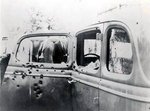
150 50 cal hits is a devastating attack. The first picture I attached is a heavy steel car hit by about 40 30-06 rounds. Multiply that by 3 and make the hits 50cal and you would probably see that car almost totally destroyed.
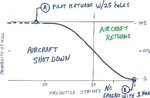
Comments about returning aircraft with damage contribute very little to the effectiveness enemy fire or aircraft survivability because only one side is known. The poorly drawn graph is a hypothetical (i.e., hallucination) meant to demonstrate the one sidedness of your report of the hits on a returned flight. Along the bottom is a scale, starting from the right, of projectile hits on an aircraft. The vertical scale represents the probability of a kill given hits. Every thing above line came back, below the line crashed. Now pilot and ground crew representing point A, which came back with 20+ holes celebrate and claim how strong their aircraft is and how weak opposing weapons are. This is solid data to proof superiority and is written about often. However aircraft B has a different perspective. This aircraft has the unfortunate situation of being downed by only one projectile. But his ground crew cannot count the one hit nor the pilot report only one hit. They don't complain about the weakness of the aircraft or effectiveness of enemy weapons. It does not make the history records other than "downed by enemy fire". In fact almost all of the aircraft below the line have little impact to history of effective weapons. Just about all reports on returned aircraft are one-sided.
Everybody has an opinion, and mine is that the F-86 with it six fast firing 50s was an effective and maybe superior match to the Mig-15 and its powerful cannon.
Now this probably confuses everybody, even me!