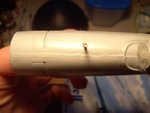
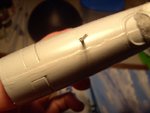
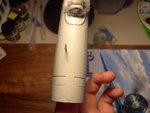
That's a good tip from Sweb there Maglar. Filling gaps, cracks or bl**dy great holes is a sort of art. There is no straight answer on how to do it, or what is the best material to use to do it, it all depends on how wide, deep, long, even etc the gap or crack is.
There are numerous materials that can be used, depending on the above, and some materials might be ideal for some jobs, but virtually impossible to apply accurately or effectively in others, due, perhaps, to angles and accessability.
One thing with 'Milliput' though, the warmer you get it, and the more you knead it, the softer it will become, and therefore easier to manipulate. Also, once squeezed into a gap, if it is then wet, it can be smoothed over with a wet finger, to the point that it is almost (but not quite) perfect, given the area concerned is accessable.
But, you need to consider the job in hand, and what might be a better method to remedy it. The materials to consider include; stretched sprue (as mentioned by Sweb) in various 'gauges', plastic rod, strip, and card. Fillers and putty's of various types can be used, as can liquid cement and superglue.
Some people, when confronted by a very small gap, use 'Tipex' (typewriter correction fluid), and you can also use PVA or Micro 'Kristal Kleer'. One I use for those very awkward tiny joints, particularly around delicate areas such as canopies, is a mix of talcum powder and gloss varnish. This can be varied in viscosity, applied by brush or toothpick, and will flow into the gap, drying smooth (if any excess is carefully wiped away) and hard, giving a virtually perfect, almost invisible seal once painted.