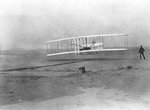
Pioneer flight has always fascinated me. I remember well reading lengthy articles about who was the "first". There's no doubt that on a technical basis, the laurels for the first heavier-then-air
controlled flight was made by the Wright Brothers.
The problems with crediting the Wrights at the time with recognition of such was the fact they kept it secret for so long, mostly for patent reasons. They were hoping for a buyer, primarily the US military. They had made the announcement, and shown their pictures, but not everyone was convinced, and who could blame them? There had been many unsuccessful attempts before, with people claiming to have flown, but never being able to prove it (or were unwilling to prove it). They saw the Wrights as two more individuals making claims but unwilling to demonstrate it as soon as they made the announcement. Thus, when Santos Dumont made his semi-controlled flight in 14-bis in Paris of 1906, he was considered the "first" as he had done it in full view of many spectators. His fans also note it was done without the use of a guide rail, catapult, or strong headwind, all of which they argue the Wright Flyer needed, therefore not achieving "true flight".
Before, there have been a few who actually made "hops" in heavier-than-air machine, all of which were uncontrolled. In France, the title of "First" is Clement Ader, who made a short hop in his bat-like contraptions "Eole" and "Avion".
On a personal note, I have no problem giving the Wright Brothers credit for the first controlled flight. I do think their decision to keep it a secret was a little foolish on their part. I think their genius was in the fact that they knew a heavier-than-air machine needed controlling surfaces. Their many tests with gliders confirmed this. I also think that by being bicycle men, this helped them understand the necessity of control. The other thing they should be given much credit for, was their use of homemade windtunnels to test their control theories. Using these methods, they demonstrated a truely scientific approach on their behalf, rather than the trial and error approach others were doing.
What I
cannot give them credit for, is their application of the early airfoil, the designs of which were basically taken from other people's research. Lets not forget, that the Wrights had a very important and well connected friend - Octave Chanute. Chanute, who had experimented with gliders of his own, was able to attend meetings between members of the early aeronautical societies which had formed in Paris. Chanute lost no time in sending the Wright Brothers copies of all the information he came across. With this wealth of information from some many other people's research, I'm hardly surprised they were able to fine tune the airfoil.
Funny enough in 2003, for the 100th anniversary of the Wright's first flight, the scene was recreated in North Carolina at Kitty Hawk with thousands of people in attendance, including President Bush. The attempts were unsucessful as it was determined that the catapult was not adjusted for maximum pull, and the headwind was weak. What was not noted by any the commentaries here (but all over TV news in France), was that around the same time, French engineering students also had their marking of the anniversary with their own replica Wright flyer, launched it from a catapult with a weight that was slightly heavier than the original one, and into a full headwind. By God it flew!



 ). Anyway, why do you think they designed the flyer with skids instead of wheels?