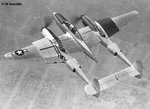
Tail flutter was quickly found to be a problem. In an attempt to fix it, small weights were attached to little booms in the middle of the elevator. This fix was derided by Kelly Johnson, who regarded the weights as useless, and in fact the buffeting eventually proved to be due to the straight connection of the wing root to the fuselage pod. A few aerodynamic changes, most particularly the addition of a wing-root fillet, solved the problem. Nonetheless, the little weights were a feature of every P-38 built from then on.
A more serious problem was "compressibility stall", the tendency of the controls to simply lock up in a high-speed dive, leaving the pilot no option but to bail out. The tail structure also had a nasty tendency to fall apart under such circumstances, and in fact this problem killed a YP-38 test pilot, Ralph Virden, in November 1940.
A USAAC major named Signa Gilkey managed to stay with a YP-38 in a compressibility lockup, riding it out until he got to denser air, where he recovered using elevator trim. This feat led to experiments that would eventually resolve the problem.
Kelly Johnson later recalled: "I broke an ulcer over compressibility on the P-38 because we flew into a speed range where no one had ever been before, and we had difficulty convincing people that it wasn't the funny-looking airplane itself, but a fundamental physical problem. We found out what happened when the Lightning shed its tail, and we worked during the whole war to get 15 more knots [28 km/h] more speed out of the P-38. We saw compressibility as a brick wall for a long time. Then we learned how to get through it."
That would not be until later, however, and the new P-38 had other defects. The most dangerous problem was that if one engine failed on takeoff, the "asymmetric power" would flip over the aircraft over and slam it upside-down into the ground. Eventually, procedures were devised to allow a pilot to deal with the situation by reducing power on the running engine, feathering the prop on the dead engine, and then increasing power gradually until the aircraft was in stable flight.
This took a skilled pilot. An unskilled pilot was dead. The P-38 went into combat with a bad reputation.
Late production P-38Js also finally amelerioated the compressibility problem, through the introduction of minor aerodynamic changes, most particularly the addition of a set of small dive flaps just outboard of the engines, on the bottom centerline of the wings. With these improvements, a USAAF pilot reported a dive speed of almost 970 km/h (600 mph) and recovered in one piece. After WW2, it was realized that the reported air speed had to be corrected for compressiblity error as well, so the actual dive speed was lower than reported.
Finally, later production of the P-38J was equipped with power-boosted flight controls, one of the first times such a system was fitted to a fighter, and did much to improve the Lightning's roll rate at high speeds and maneuverability.
http://en.wikipedia.org/wiki/P-38_Lightning