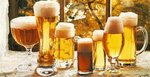
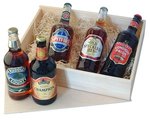
There is a reason why. Some people just dont have culture in beer!
Here is some info on some of my favorite German Beer. All of this is taken from the:
www.germanbeerinstitute.com
There are actually more than 4 dozen different kinds of German beer and litterally thousands of breweries making there own brands.
Enjoy:
KRISTALLWEIZEN
Pronunciation guide for English-speakers:
"chriss-ull-vit-sssen" (pronounce "ull" as in "lull")
Definition:
Literally "crystal wheat." A Kristallweizen is a filtered pale Weissbier or Hefeweizen, the German wheat ale. It pours "crystal"-clear rather than yeast-turbid. In all other respects, it is not different from an unfiltered wheat beer. It is spritzy-effervescent and refreshing and appealing to the eye. Like its Hefeweizen counterpart, Kristallweizen develops a richly-textured, firm, white head in the glass. Several Weissbier breweries export their Kristallweizen along with their Hefeweizen to the United States.
ALTBIER
AKA:
Alt, Düsseldorfer Alt
Pronunciation guide for English-speakers:
"ullt-beer"
Definition:
One of only a handful of traditional German ales. Altbier is Copper-colored, cool-fermented, cold-conditioned, clean-tasting, with an aromatic hop-presence, a firm creamy head, a medium body, and a dry finish. It is indigenous to the Rheinland in the northwestern part of the country. The best known Altbiers come from the Dösseldorf, the capital city of the state of North Rine-Westphalia.
Helles
Hell, Helles Export, Helles Lager(bier), Export Helles, Urhelles, Urtyp-Helles, Edelhelles, Spezial Helles
Pronunciation guide for English-speakers:
"hell-us"
Definition:
Hell is the German adjective for "light," while Helles is a noun used in the sense of "a light one." But unlike in North America, this designation refers to color only, not to the beer's caloric or alcoholic strength, which is a substantial 4.7 to 5.4 percent by volume. If there is one beer style that typifies the greatness especially of Bavarian beer-making, it is this straw-blond lager. Depending on the brewery, this beer style issold under various designations on the label. Because the Munich Hellesis historically the first Munich blond lager, it is also sometimes marketed in English-speaking countries under the designation of "Munich Original Lager." You may also encounter it on the shelves under the label of "Munich Light" to appeal to consumers who might not be familiar with the term Helles.
Related beer styles:
Dortmunder, Pils/Pilsner/Pilsener, Radler(mass), Alsterwasser
KÖLSCH
Pronunciation guide for English-speakers:
"Cœllsh" (pronounce the "ö" like a French "œ" as in bœuf)
Definition:
One of only a handful of traditional German ales. Kölsch is the local brew of the city of Cologne ("Köln" in German). It is one of the palest German beers made. It is Germany's answer to the British pale ale. It shares a history with the copper-colored Altbier made in Düsseldorf, some 44 km down the Rhine from Cologne. Just as the British pale ale emerged from the British broiwn ale in the 19th century, when pale malt became readily available, so did the Kölsch separate itself from tAltbier around the same time. In 1948, the brewers of Kölsch joined forces in the so-called Kölsch Convention and formalized the Kölsch style in terms of modern brewing specifications. Kölsch, like Altbier, gets its characteristic, slightly fruity flavor from its own special ale yeast, with which the brew is cool-fermented and then aged and mellowed (or "lagered") near the freezing point. Kölsch is always served in a straight-side, narrow, 0.2-liter (6¾ fluid ounces) glass called a Stange ("stick," "pole" or "rod"). Kölsch is available only sporadically in the United States. The two brands that can be found in specialty beer stores in some areas of the coutnry are Reissforf and Gaffel.
PILS
AKA:
Pilsner, Pilsener
Pronunciation guide for English-speakers:
"pills"
Definition:
Pils is arguably the most successful beer style in the world. Nine out of ten beers drunk in the worldtoday are made according to the Pilsner style or a style directly derived from it. Pils is a very blond, brillinatly clear, moderately effervensent lager, modeled largely in a beer style invented in 1842 in the Czech city of Pilsen. Pils is often strongly hopped with an assertive up-front bitterness bite. It emerged in the north of Germany. Perhaps the classic representation of the style is Jever Pils, a brew from a small by the same name. Jever Pils is being imported into the United Sates and available in many parts of the country.
Hefeweizen
AKA:
Weissbier, Weizenbier, Weizen, Wheat Ale
Pronunciation guide for English-speakers:
"heyh-foh-vy-tzen" (Do NOT pronounce it "Heffea-vizen"!
Definition:
Another name for Weissbier. "Hefe" means yeast, and "Weizen" means wheat, so Hefeweizen is "yeast wheat." Germans prefer to call the brew Weissbier, while Northamericans prefer the term Hefeweizen. The beer is yeast turbid, because it is unfiltered. For more on this style, see Weissbier.



 )
)